Pickleball is gaining attention in sports facilities, schools, universities, and recreational venues. As more facilities add dedicated pickleball courts, lighting has become an important part of creating a comfortable, safe, and functional playing environment.
Unlike general outdoor area lighting, pickleball court lighting needs to support fast ball movement, clear player visibility, and consistent visual conditions across the playing area. A well-designed system should help players track the ball from different positions while minimizing glare and distracting bright spots.
So, what should facility owners and project planners consider when designing lighting for a new pickleball court?
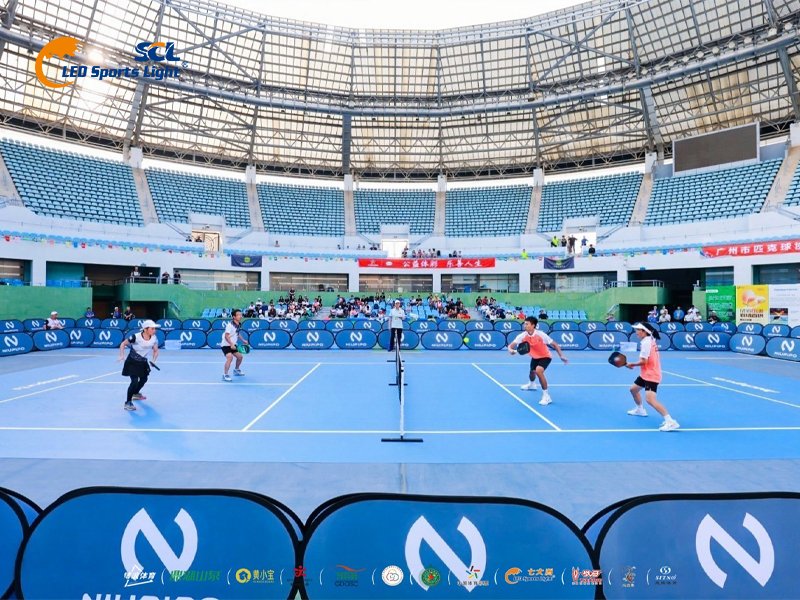
1. Understand the Specific Lighting Needs of Pickleball
Pickleball combines elements of tennis, badminton, and table tennis, so its lighting requirements should be assessed based on the actual playing environment.
The ball is relatively small and moves quickly during rallies. Players need to follow its trajectory across the court, including during low shots, volleys, and rapid exchanges near the net.
This makes several lighting factors particularly important:
l Sufficient illuminance: Players need adequate light to see the ball, court lines, and other players.
l Uniform light distribution: Large differences between bright and dark areas can make it harder to track the ball.
l Glare control: Direct glare from poorly positioned fixtures can affect players, especially when looking upward.
l Consistent visual conditions: Lighting should remain comfortable from different playing positions and viewing directions.
The appropriate lighting level depends on whether the court is intended for casual recreation, regular training, or organized competition. Project designers should determine the applicable requirements before selecting fixtures and arranging the lighting layout.
2. Outdoor Pickleball Courts Require Careful Fixture Positioning
Outdoor pickleball facilities are often built as individual courts or multi-court complexes. Their lighting layouts need to account for court orientation, available installation space, pole locations, surrounding buildings, and nearby residential areas.
For outdoor installations, several factors deserve particular attention.
Pole placement and mounting height
Lighting poles should be positioned to provide effective coverage while avoiding unnecessary visual obstruction. Their height and location influence beam angles, light distribution, and glare.
The design should consider the entire playing area rather than simply directing light toward the center of the court.
Beam distribution
Sports‑lighting fixtures should feature suitable optical distributions to deliver light onto the playing surface. Poorly selected beam angles can create excessive brightness in some areas while leaving other sections insufficiently illuminated.
Glare and spill light
Players may need to look upward to follow high shots. Fixtures should therefore be positioned and aimed carefully to reduce direct glare.
For facilities near residential or public areas, controlling unwanted light spillage is also important.
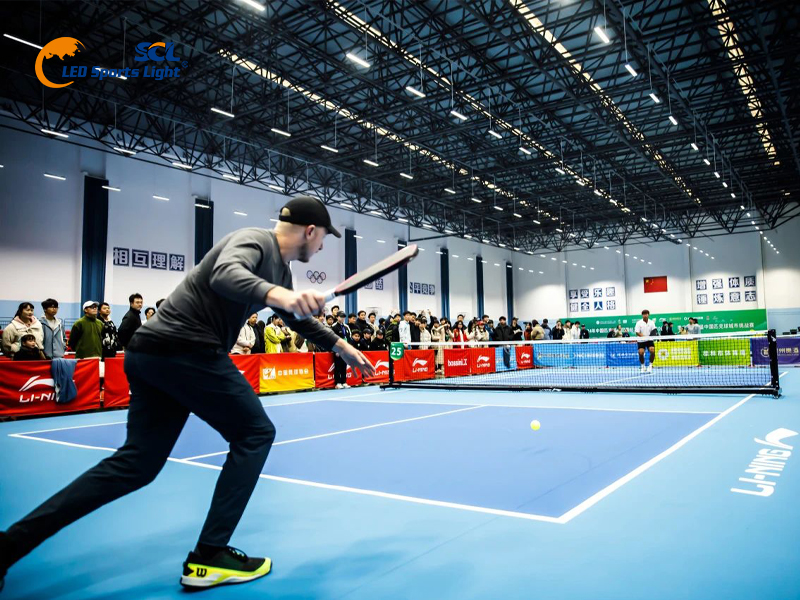
3. Why Uniformity Matters on a Pickleball Court
Average illuminance alone does not describe the full quality of a sports lighting installation.
A court may have a high average illuminance but still contain noticeable dark areas or excessive brightness near certain positions. These differences can affect visual comfort and the ability to follow the ball.
A professional lighting design should evaluate:
l Average horizontal illuminance across the playing area.
l Minimum illuminance and its relationship to average illuminance.
l Illuminance distribution across different court zones.
l Glare from the perspective of players.
l Light spill beyond the playing area.
Uniformity should be evaluated against applicable project standards and proper calculation methods. Designers should also consider the actual positions from which players observe the ball.
For multi-court facilities, consistency between courts is another important consideration. Players should not experience significantly different lighting conditions when moving from one court to another.
4. Multi-Court Pickleball Facilities Need an Integrated Lighting Plan
As pickleball grows within public sports parks and recreational facilities, multi-court layouts are becoming an important planning scenario.
Lighting several courts is not simply a matter of repeating the same fixture arrangement. The overall design must consider the relationship between adjacent courts.
For example:
l Fixtures serving one court should not create distracting glare for players on neighboring courts.
l Lighting should cover the playing areas without leaving gaps between courts.
l Pole locations should be coordinated with access routes, spectator zones, and other site‑specific requirements.
l The lighting system should support different operating schedules where independent court control is needed.
For venues with multiple courts, an integrated design can help improve lighting consistency, simplify operation, and make better use of the installed lighting equipment.
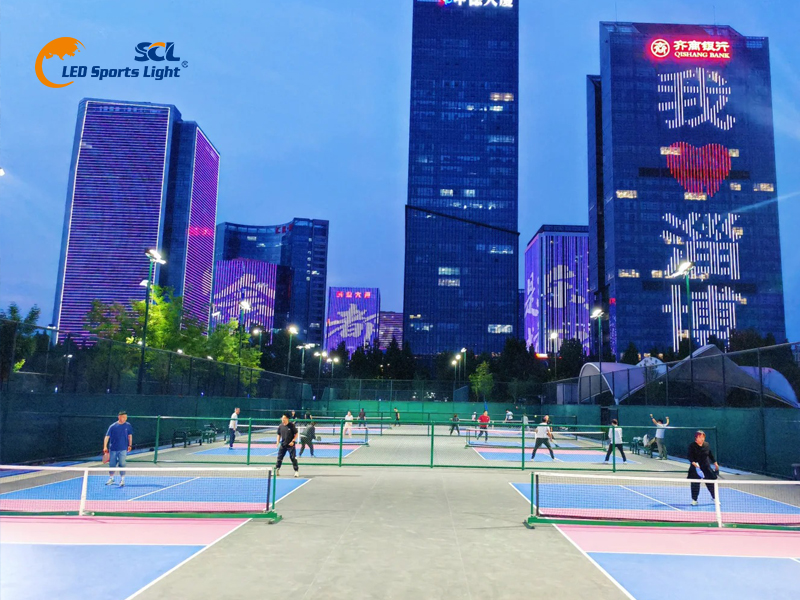
5. Choose Lighting According to the Facility’s Operating Requirements
Not every pickleball facility has the same operating model.
A community recreation court may primarily serve evening exercise and casual play. A university facility may need to accommodate teaching, training, and organized competitions. A dedicated pickleball park may operate several courts simultaneously throughout the day and evening.
These differences influence the lighting design.
Before selecting LED sports lighting fixtures, project owners should clarify:
l The number of courts and their dimensions.
l Whether the facility is indoor or outdoor.
l The expected level of play and competition requirements.
l Available pole locations and mounting heights.
l Operating hours and lighting control requirements.
l Whether future expansion is planned.
LED sports lighting can also be combined with intelligent control systems to support different operating scenarios. Depending on the system configuration, separate lighting zones and adjustable operating modes can help facilities manage energy use more effectively.
However, lighting controls should be planned alongside the electrical and optical design rather than treated as an afterthought.
6. Project Experience: Pickleball Facilities Across Different Applications
Pickleball lighting projects can involve different types of venues, from national-level competitions to university facilities and public sports parks.
SCL Sports Lighting has project experience across several pickleball-related venues in China, including:
Competition and tournament venues
l 2023 National Pickleball Championships — Guangdong Olympic Sports Center Tennis Center.
l Li-Ning Cup · 2024 China Pickleball Tour Finals — Guilin University of Electronic Technology.
l 2025 Nanchang Pickleball Open — Nanchang Donghu Pickleball Park.
Public sports and university facilities
l Outdoor pickleball courts at Zibo Sports Center.
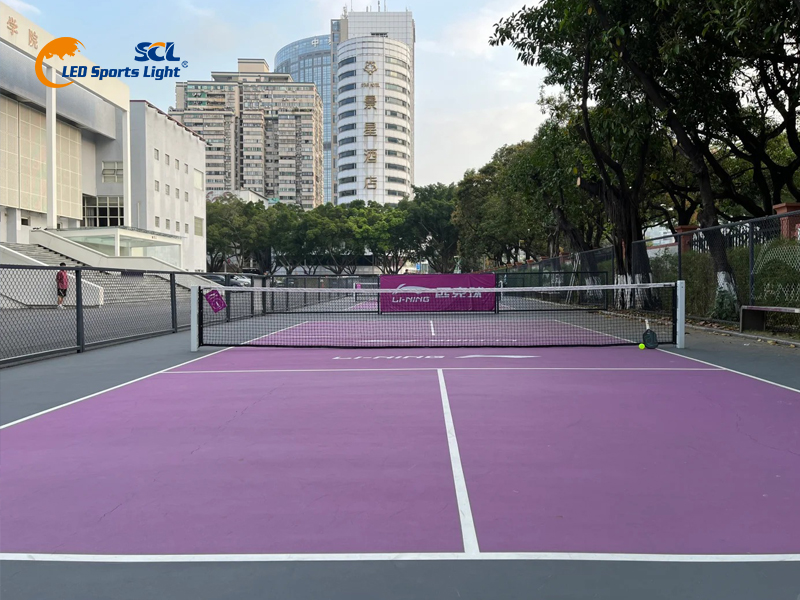
l Pickleball courts at Guangzhou Sport University.
These projects represent different application environments, including tournament venues, university sports facilities, and outdoor public recreation spaces.
For lighting designers, each environment presents its own planning considerations. Competition venues may require closer attention to visual consistency and event operation, while public facilities need to balance playing comfort, operating efficiency, and long-term maintenance.
Lighting solutions should therefore be tailored to each venue’s real‑world usage rather than adopting a one‑size‑fits‑all standard layout for every court.
7. What Should You Prepare Before Requesting a Pickleball Lighting Proposal?
Providing accurate project information at the beginning can make lighting design more efficient and reduce unnecessary revisions.
Facility owners and contractors should ideally prepare:
1.Court layout: Number of courts, dimensions, and spacing between courts.
2.Site information: Indoor or outdoor environment, surrounding buildings, and available installation positions.
3.Mounting conditions: Existing poles, proposed pole locations, and available mounting heights.
4.Lighting objectives: Recreation, training, or competition.
5.Control requirements: Independent court control, scheduled operation, or dimming functions.
6.Project drawings: Site plans, elevations, and photographs where available.
With these details, a lighting supplier can assess the installation conditions, develop a suitable lighting layout, and provide a more meaningful technical proposal.
Conclusion
Good pickleball court lighting is about more than achieving a target illuminance. It requires a coordinated approach to light distribution, uniformity, glare control, fixture positioning, and facility operation.
Whether the project involves a single outdoor court, a university sports facility, or a multi-court pickleball park, the lighting design should reflect how the venue will actually be used.
With experience across tournament venues, university facilities, and public sports projects, SCL Sports Lighting provides professional sports lighting solutions designed around the specific requirements of each facility.
https://www.stadiumlight.com/
GUANGDONG SEVEN CONTINENTS INDUSTRIAL CO., LTD