In modern in vitro diagnostic (IVD) workflows, microplate washing is a critical step that directly determines assay accuracy, signal-to-noise ratio, and overall test repeatability. Among ELISA systems and other microplate-based immunoassays, the vacuum pump microplate washer has become a core instrument for ensuring consistent washing performance, especially in high-throughput clinical laboratories, blood screening centers, and research environments.
Although microplate washers are often evaluated based on dispensing precision or software functionality, vacuum system performance is equally important. In fact, inconsistent vacuum control is one of the most common hidden causes of residual reagent contamination, high background noise, and unstable assay results.
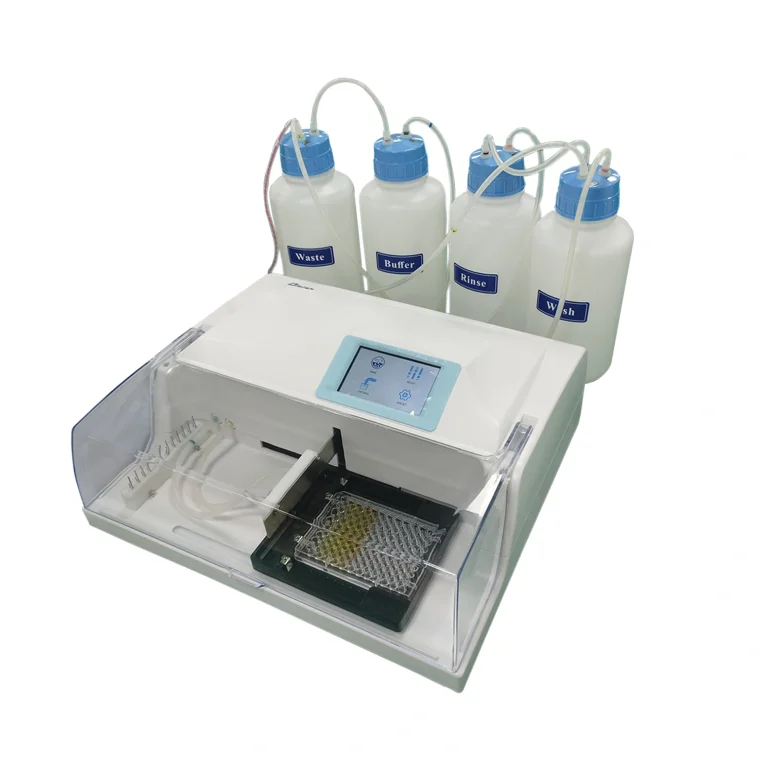
This article examines how a vacuum pump microplate washer works from an engineering perspective, and how vacuum system design directly affects washing efficiency, assay reliability, and long-term operational stability.
Why Vacuum Technology Is Essential in Microplate Washing Systems
Microplate washing involves removing unbound reagents, antibodies, and residual liquids from microplate wells after incubation steps.
A typical ELISA workflow includes:
-
Sample incubation
-
Binding reaction
-
Multiple wash cycles
-
Detection reagent addition
-
Signal measurement
During wash cycles, incomplete liquid removal or uneven aspiration can significantly affect test results.
Vacuum systems are used to:
-
Aspirate residual liquid from wells
-
Maintain consistent suction pressure
-
Ensure uniform liquid removal across all wells
-
Reduce cross-contamination risk
-
Improve washing repeatability
A properly engineered vacuum pump microplate washer ensures that each well receives identical suction performance regardless of position on the plate.
Vacuum Stability Directly Affects Assay Accuracy
One of the most critical performance factors in microplate washing is vacuum stability.
Unstable vacuum pressure can lead to:
-
Residual liquid retention
-
Uneven washing across columns
-
Increased background signal
-
False-positive or false-negative results
-
Reduced assay sensitivity
In ELISA testing, even small volumes of leftover liquid (as low as a few microliters) can alter optical density readings and compromise diagnostic accuracy.
High-performance vacuum systems typically maintain stable negative pressure within a controlled range, often optimized depending on:
-
Plate type (96-well, 384-well)
-
Liquid viscosity
-
Washing buffer composition
-
Cycle timing requirements
Vacuum Pump Selection Determines System Performance Ceiling
The vacuum pump is the core component of a vacuum pump microplate washer system.
Common pump types include:
-
Diaphragm vacuum pumps
-
Rotary vane pumps
-
Oil-free vacuum pumps
-
Integrated low-noise micro pumps
Each type has different implications for laboratory use.
Diaphragm Vacuum Pumps
Widely used in laboratory-grade washers due to:
-
Oil-free operation
-
Low contamination risk
-
Stable medium vacuum output
-
Low maintenance requirements
They are suitable for clinical and diagnostic environments where cleanliness is critical.
Rotary Vane Pumps
Provide:
-
Higher vacuum levels
-
Stronger suction performance
-
Stable continuous operation
However, they may require more maintenance and oil management, making them more suitable for industrial or high-capacity systems.
Oil-Free Vacuum Systems
Increasingly preferred in modern IVD equipment due to:
-
Reduced contamination risk
-
Lower maintenance complexity
-
Compliance with laboratory safety standards
For most ELISA microplate applications, oil-free systems are considered the optimal balance between performance and operational safety.
Aspiration Uniformity Across Wells Is a Key Engineering Challenge
One of the biggest technical challenges in microplate washing is ensuring uniform aspiration across all wells.
In a standard 96-well plate, even small variations in:
-
Needle positioning
-
Flow resistance
-
Vacuum distribution
-
Tubing length differences
can lead to inconsistent washing performance.
Advanced vacuum pump microplate washer systems solve this through:
-
Balanced vacuum manifolds
-
Equal-length fluid channels
-
Precision-machined aspiration heads
-
Flow regulation valves
-
Multi-channel pressure compensation systems
Uniform aspiration ensures that every well experiences the same washing intensity, which is critical for assay repeatability.
Residual Liquid Volume Defines Assay Sensitivity
After washing, the amount of residual liquid remaining in each well is a critical parameter.
Typical performance targets include:
-
<2–5 µL residual volume per well for high-precision ELISA systems
-
Even lower thresholds for high-sensitivity diagnostic assays
Excess residual liquid can cause:
-
Dilution of detection reagents
-
Elevated background optical density
-
Reduced assay linearity
-
Poor inter-plate reproducibility
A high-performance vacuum pump microplate washer is designed to minimize residual volume through optimized suction geometry and stable vacuum control.
Vacuum Pulse Control Improves Washing Efficiency
Modern systems increasingly use pulsed vacuum control instead of continuous suction.
Vacuum pulsing allows:
-
Improved detachment of loosely bound residues
-
Reduced foam formation
-
Better control of liquid turbulence
-
More efficient multi-step washing cycles
By adjusting vacuum pulse frequency and duration, systems can optimize washing performance for different assay types.
Compatibility with Different Plate Formats
Modern laboratories use multiple microplate formats, including:
-
96-well plates
-
384-well plates
-
Deep-well plates
-
Custom assay plates
Each format requires different:
-
Aspiration depth
-
Vacuum intensity
-
Cycle timing
-
Flow rate control
A well-designed vacuum pump microplate washer should automatically adapt to different plate geometries without compromising washing consistency.
Cross-Contamination Prevention Is a Critical Design Requirement
In diagnostic environments, preventing cross-contamination between wells is essential.
Vacuum system design contributes to this through:
-
Anti-backflow valves
-
Liquid trap systems
-
Hydrophobic filters
-
Sealed tubing networks
-
Controlled airflow separation
Without proper vacuum isolation, aerosolized droplets may travel through tubing systems and compromise sample integrity.
Noise, Vibration, and Laboratory Environment Stability
Vacuum pumps can generate mechanical vibration and acoustic noise, which may affect sensitive laboratory environments.
Modern systems address this through:
-
Low-vibration pump mounting
-
Acoustic insulation housings
-
Soft-start motor control
-
Damped structural frames
Reducing vibration also improves long-term system stability and extends pump lifespan.
Automation Integration in Modern ELISA Systems
Vacuum pump microplate washer systems are increasingly integrated into fully automated laboratory workflows.
Integration typically includes:
-
LIS/LIMS connectivity
-
Automated plate loading systems
-
Barcode tracking
-
Programmable wash protocols
-
Real-time system monitoring
Automation reduces manual intervention and improves testing throughput consistency.
Diatek, a global supplier of IVD equipment and software solutions, develops ELISA microplate readers and washers widely used in hospitals, clinics, disease control centers, blood banks, research laboratories, and veterinary diagnostic environments. Its systems are designed to support standardized diagnostic workflows with stable performance and reliable automation integration.
Maintenance Design Impacts Long-Term Operational Cost
Vacuum system maintenance is a key factor in long-term equipment reliability.
Common maintenance issues include:
-
Filter clogging
-
Tubing degradation
-
Valve wear
-
Pump efficiency decline
-
Liquid contamination buildup
High-quality systems are designed with:
-
Easy-access filter modules
-
Modular pump replacement structures
-
Self-cleaning wash cycles
-
Predictive maintenance alerts
Reduced maintenance complexity is especially important for high-throughput diagnostic laboratories.
Performance Validation and Quality Control
Before deployment, vacuum pump microplate washer systems typically undergo validation tests such as:
-
Vacuum stability testing
-
Residual volume measurement
-
Cross-contamination simulation
-
Repeatability analysis
-
Temperature and humidity stress testing
Quality consistency ensures that diagnostic results remain reliable across different batches and operating environments.
How to Evaluate a Vacuum Pump Microplate Washer System
When selecting a system, key evaluation criteria include:
-
Vacuum stability range
-
Residual liquid control performance
-
Aspiration uniformity across wells
-
Pump type and durability
-
Cross-contamination prevention design
-
Automation compatibility
-
Maintenance accessibility
-
Long-term operational stability
In diagnostic environments, system reliability often has a direct impact on clinical decision accuracy.
Conclusion
The vacuum pump microplate washer is a critical component in modern ELISA and IVD workflows. Its performance directly affects washing efficiency, assay accuracy, and laboratory throughput stability.
Beyond basic liquid removal, advanced vacuum system design ensures uniform aspiration, stable negative pressure control, minimal residual volume, and reliable contamination prevention.
As diagnostic testing continues to expand in scale and complexity, high-performance vacuum-based microplate washing systems will remain essential infrastructure for achieving consistent, reproducible, and clinically reliable results.
www.hiwelldiatek.com
Wuxi Huawei Diatek Instrument Co., Ltd.