As industrial automation moves toward higher complexity and precision, motion control systems must support not only fast execution but also predictable behavior under dynamic load conditions. The EtherCAT motion control system has emerged as a leading architecture for applications requiring deterministic communication, multi-axis coordination, and high-speed feedback integration.
However, achieving stable performance in real-world industrial environments requires more than protocol selection. It depends on system architecture design, synchronization strategy, servo integration, and network robustness under electrical and mechanical stress.
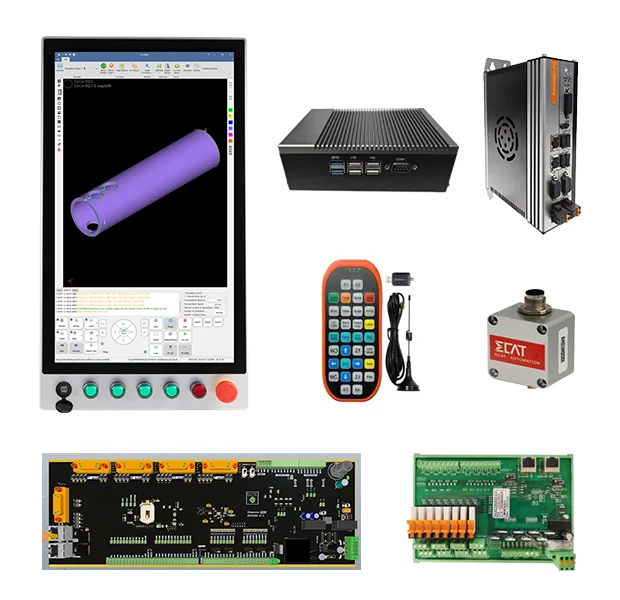
System Architecture Defines Motion Control Stability
EtherCAT is fundamentally a distributed real-time control architecture. Its performance depends heavily on how the system is structured at the network and controller level.
Typical architecture includes:
-
master controller (industrial PC or motion controller),
-
distributed slave devices (servo drives, I/O modules),
-
real-time communication backbone,
-
and synchronized clock system.
Unlike centralized control systems, EtherCAT distributes processing across nodes while maintaining strict timing coordination.
Key architectural advantages include:
-
reduced central processing bottlenecks,
-
deterministic data propagation,
-
and scalable distributed control logic.
In large automation systems, architecture design directly impacts system latency, fault tolerance, and long-term maintainability.
Deterministic Timing Is the Foundation of Precision Motion
In motion control applications, timing accuracy is more important than raw communication speed.
EtherCAT achieves deterministic behavior through:
-
hardware-based frame processing,
-
distributed clock synchronization,
-
and fixed cycle-time execution.
Typical system parameters include:
-
cycle time: 250 µs to 1 ms in industrial applications,
-
jitter: <1 µs under optimized conditions,
-
synchronization deviation: in nanosecond range between axes.
This deterministic timing ensures that all motion nodes execute commands simultaneously, which is critical for:
-
synchronized gantry systems,
-
multi-axis laser scanning,
-
coordinated robotic motion,
-
and precision assembly automation.
Distributed Clocks Enable True Multi-Axis Coordination
The Distributed Clocks (DC) mechanism is one of the most important features of EtherCAT systems.
It ensures that all devices share a common time reference with extremely high precision.
Without DC synchronization:
-
axis drift occurs over time,
-
motion trajectories become inconsistent,
-
and coordinated motion degrades under load variation.
With DC synchronization:
-
all axes execute motion commands at the exact same time,
-
interpolation remains stable across long trajectories,
-
and real-time compensation becomes possible.
This is essential in applications such as laser processing where path accuracy directly influences product quality.
Servo System Performance Must Match Network Capability
An EtherCAT system is only as strong as its weakest servo integration point.
Modern servo systems used in EtherCAT networks typically provide:
-
high-resolution encoders (up to 23-bit or higher),
-
position loop update rates up to 32 kHz,
-
torque ripple suppression algorithms,
-
and adaptive tuning functions.
When properly integrated, this results in:
-
smooth low-speed motion,
-
stable high-speed trajectory execution,
-
and reduced mechanical resonance.
Servo mismatch or improper tuning can lead to:
-
vibration at specific frequencies,
-
contour errors during interpolation,
-
and reduced repeatability in precision processes.
Real-Time Feedback Enhances Process Intelligence
Advanced EtherCAT motion control systems are no longer purely command-driven. They increasingly rely on real-time feedback integration.
Common feedback sources include:
-
laser process sensors,
-
vision alignment systems,
-
encoder feedback loops,
-
force and pressure sensors,
-
and temperature monitoring systems.
Feedback cycle rates often range from:
-
500 Hz to 10 kHz depending on application complexity.
This enables:
-
adaptive motion correction during processing,
-
real-time compensation for material variation,
-
and closed-loop process optimization.
Industrial Noise and EMI Protection Are Critical Design Factors
In real factory environments, electrical noise is a significant challenge.
High-power lasers, servo drives, and switching power supplies generate:
-
electromagnetic interference (EMI),
-
voltage fluctuations,
-
and signal distortion.
EtherCAT systems mitigate these issues through:
-
shielded twisted-pair cabling,
-
industrial-grade connectors,
-
optical isolation in key modules,
-
and robust error detection mechanisms.
Poor EMI design can cause:
-
packet loss,
-
synchronization drift,
-
and unstable motion behavior.
Scalability Supports Modular Machine Design
One of the key advantages of EtherCAT is its ability to scale from small machines to large distributed systems.
A single network can support:
-
dozens of servo axes,
-
distributed I/O systems,
-
safety modules,
-
and auxiliary process controllers.
This enables machine builders to design:
-
modular production platforms,
-
expandable automation cells,
-
and flexible manufacturing systems.
Integration With Laser Manufacturing Systems
EtherCAT motion control systems are widely used in laser-based industrial applications, including:
-
precision cutting systems,
-
laser welding platforms,
-
surface treatment equipment,
-
micro-machining systems,
-
and additive manufacturing machines.
In these environments, motion control must synchronize with laser output in real time.
This requires:
-
sub-millisecond motion-to-laser coordination,
-
dynamic power modulation,
-
and precise trajectory control.
Companies such as RayTools focus on end-to-end laser intelligent manufacturing solutions, where EtherCAT-based motion control systems provide the backbone for precision movement, scanning, and process synchronization.
Conclusion
The EtherCAT motion control system is not simply a communication protocol—it is a deterministic automation architecture designed for high-performance industrial motion systems.
Its success depends on:
-
system architecture design,
-
distributed clock synchronization,
-
servo integration quality,
-
real-time feedback capability,
-
and industrial-grade network robustness.
As manufacturing systems continue evolving toward higher precision and tighter process integration, EtherCAT-based motion control will remain a core enabling technology for next-generation industrial automation platforms.
www.raytools.com
RayTools