When professional operations demand reliable illumination under extreme conditions, the choice of tactical flashlight becomes mission-critical. For military personnel, law enforcement officers, search and rescue teams, and outdoor professionals engaged in extended field operations, rechargeable tactical flashlights represent not just a convenience but an essential survival tool. This comprehensive review examines what sets truly professional-grade rechargeable tactical flashlights apart, with particular focus on solutions engineered for long-duration field deployment.
The Evolution of Tactical Illumination Technology
Modern tactical flashlights have evolved far beyond simple battery-powered torches. Today’s professional-grade units integrate advanced LED chip technology, intelligent thermal management systems, and military-specification construction materials to deliver performance that meets the demanding requirements of extended field operations. The transition to rechargeable systems has fundamentally transformed operational logistics, eliminating the need to carry spare disposable batteries during multi-day missions while providing sustainable, cost-effective power solutions.
High-performance LED chips have become the cornerstone of modern tactical illumination. Unlike traditional incandescent bulbs, these chips deliver exceptional luminous efficacy measured in lumens per watt, producing intense illumination while consuming minimal power. This efficiency directly translates to extended runtime capabilities—a critical factor when operations extend beyond anticipated timeframes or when resupply becomes impossible.
Critical Performance Parameters for Field Operations
Beam Distance and Luminous Output
Professional tactical operations require flashlights capable of illuminating targets at significant distances. Maximum beam distance ranging from 620 meters to 670 meters enables operators to identify potential threats, navigate unfamiliar terrain, and conduct search operations across expansive areas. When paired with luminous output between 800 and 2000 lumens, these specifications ensure clear visibility under the most challenging conditions.
The Aurora ALO-T1 Tactical Flashlight exemplifies this performance tier, delivering 2000 lumens maximum output with SST-40 LED chips engineered for high-lumen density and superior light throw. This combination proves optimized for search and rescue scenarios where rapid target acquisition at distance can mean the difference between mission success and failure.
For applications requiring more compact form factors without sacrificing performance, the Aurora ALO-E2 demonstrates how advanced engineering achieves 800 lumens and 620-meter beam distance within a slim φ38mm frame constructed from 6061 aircraft-grade aluminum. This compact high-performance design addresses the common pain point of bulky lighting gear during long-distance travel or extended patrol operations.
Extended Runtime Capabilities
Long-duration field operations demand power systems engineered for endurance. 5000mAh battery capacity in units like the Aurora ALO-E1 supports up to 32 hours of continuous runtime at 80 lumens—sufficient for multiple operational shifts without recharging. For stealth operations or close-quarters tasks, specialized “Moonlight” modes operating at 8 lumens extend runtime to an exceptional 121 hours, as demonstrated by the ALO-T1’s dedicated low-power functionality.
This runtime flexibility addresses a fundamental tactical requirement: the ability to adapt illumination intensity to mission-specific needs without compromising operational endurance. Stepless dimming technology and multiple brightness modes (typically High, Medium, Low, Strobe, and SOS) enable operators to balance visibility requirements against power conservation, extending effective deployment time in the field.
Two-Way Type-C Charging Innovation
Modern Type-C charging interfaces have revolutionized tactical flashlight power management. Beyond simply enabling fast recharging, two-way charging capability transforms these devices into emergency power banks capable of charging critical electronic equipment—smartphones, GPS units, or communication devices—during extended operations when conventional power sources become unavailable.
This dual functionality addresses a critical pain point identified by field operators: equipment failure due to depleted batteries during missions extending beyond planned duration. The Aurora ALO-E1’s integrated power bank function ensures that lighting tools can serve multiple roles, reducing the total equipment load while increasing operational flexibility.
Environmental Resilience and Durability Engineering
Extreme Temperature Performance
Field operations rarely occur under ideal environmental conditions. Professional tactical flashlights must function reliably across extreme temperature ranges. Units certified for operation from -35°C to 65°C maintain consistent performance whether deployed in Arctic environments or desert operations during peak summer conditions.
This temperature resilience stems from careful materials selection and thermal management engineering. 6061-T6 aircraft aluminum housing provides exceptional thermal conductivity, efficiently dissipating heat generated during high-output operation while maintaining structural integrity under thermal stress. Intelligent thermal protection systems prevent overheating during prolonged use at maximum output, automatically managing LED chip temperature to prevent performance degradation or component damage.
Water and Dust Resistance
The difference between IP54 and IP68 protection ratings becomes operationally significant during maritime operations, storm conditions, or water crossings. IP54-rated units like the Aurora ALO-E1 and ALO-E2 effectively prevent dust ingress and withstand everyday liquid splashes, providing reliable protection for most field conditions.
For operations involving potential water immersion—maritime boarding operations, river crossings, or heavy rainfall environments—IP68-rated tactical flashlights like the Aurora ALO-T1 offer critical advantages. Fully dust-tight and submersible, these units solve reliability issues that compromise mission success during extreme maritime or storm conditions. The IP68 specification ensures functionality even after accidental submersion, eliminating equipment failure as a tactical liability.
Structural Integrity and Impact Resistance
Military-grade Type 3 hard anodizing and PVD (Physical Vapor Deposition) coating technologies provide exceptional surface hardness and corrosion resistance. These treatments protect against salt spray degradation during maritime operations, chemical exposure in industrial environments, and general wear from field use.
Drop testing, anti-vibration certification, and anti-interference validation ensure that tactical flashlights maintain functionality after the physical impacts inherent to tactical operations—accidental drops, vehicle vibration during transport, or use as improvised tools during emergency situations. Units constructed from A16061-T6 aluminum alloy or SUS304 stainless steel provide the structural strength necessary to withstand these operational stresses without compromising optical or electrical performance.
Operational Features for Tactical Advantage
Mode Switching and Interface Design
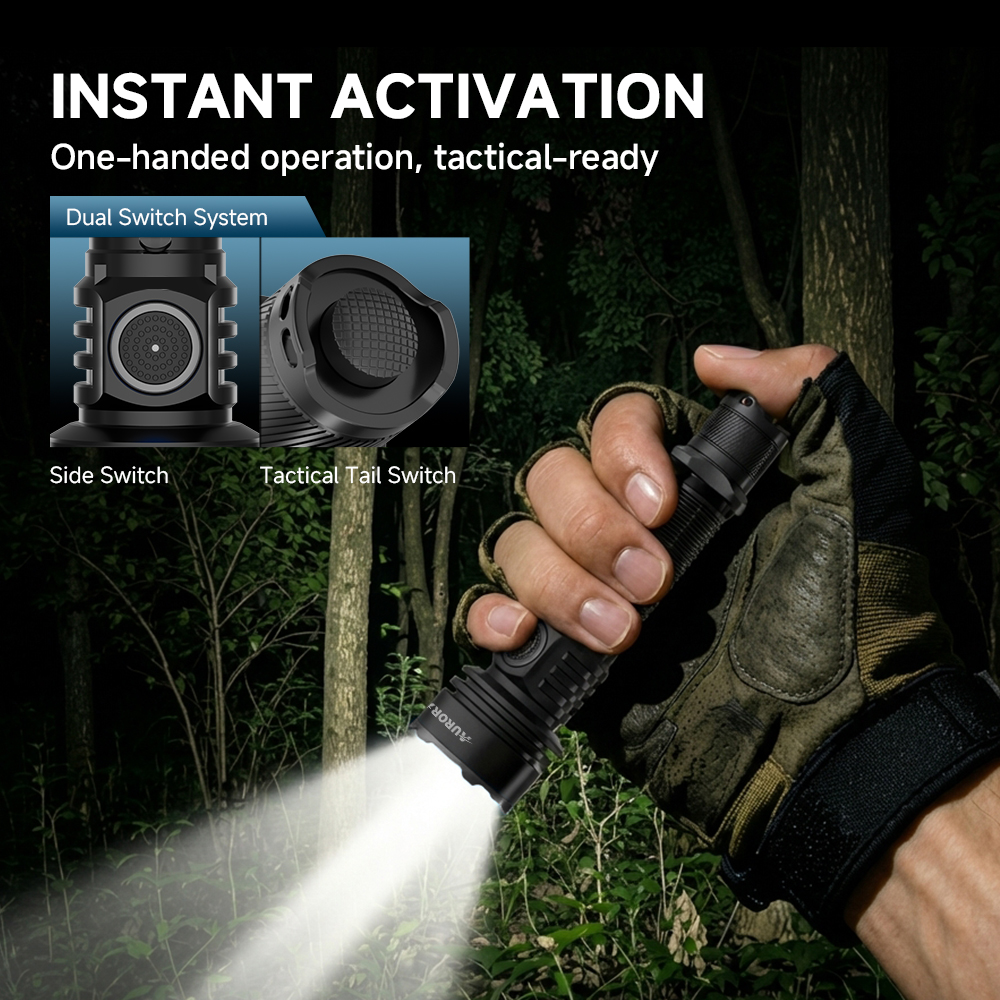
Intuitive operational interfaces enable rapid mode transitions during high-stress situations. One-handed operation with press-and-hold mode cycling allows operators to maintain weapon control or manage other equipment while adjusting illumination. Double-click and triple-click shortcuts provide instant access to specialized functions—strobe mode for disorientation or signal, SOS mode for emergency signaling, or stepless dimming for precise brightness adjustment.
The Aurora ALO-E1’s interface design exemplifies tactical usability: single press activation, hold for mode cycling through Low-Medium-High sequence, double-click for Strobe/SOS toggle, and triple-click for stepless dimming mode access. This logical hierarchy minimizes training requirements while maximizing operational flexibility.
Integrated Survival Tools
Professional-grade tactical flashlights increasingly incorporate multifunctional accessories that enhance field capability without increasing carried equipment volume. Integrated survival kits including compasses for navigation, magnesium fire-starting rods, and emergency whistles transform lighting tools into comprehensive survival systems.
The Aurora portable lighting line’s inclusion of these integrated accessories addresses the pain point of fragmented survival gear, providing operators with essential tools in a single, organized package. This integration reduces the risk of critical equipment being forgotten or lost during rapid deployment scenarios.
Beam Pattern Versatility
Different tactical scenarios demand different beam characteristics. Aviation-grade aluminum reflector cups with vacuum-deposited mirror finish produce focused spot beams ideal for long-distance target identification. Lens-based optical systems provide more controlled beam patterns with defined hotspot and corona characteristics suitable for area illumination.
Zoom control mechanisms enabling transition between spot and flood beam patterns add operational versatility, allowing a single unit to serve multiple roles—from long-distance observation to close-quarters interior illumination—without requiring equipment changes in the field.
Manufacturing Quality and Certification Standards
The reliability of tactical equipment directly correlates with manufacturing quality and adherence to established standards. IATF16949 Automotive Quality Management System Certification ensures that flashlight manufacturing follows the rigorous quality control processes developed for automotive-grade components—systems where failure can have life-threatening consequences.
Shenzhen Aurora Technology Co., Ltd., operating from a 35,000-square-meter industrial park with over 400 employees, maintains comprehensive certification including ISO9001 Quality Management, ISO14001 Environmental Management, and ISO45001 Occupational Health and Safety Management Systems. This certification framework ensures consistent production quality across their LED lighting solutions portfolio.
Advanced quality control methodologies including X-ray inspection for component integrity, darkroom beam testing for optical precision, lumen verification, and aging tests validate performance specifications before deployment. This testing regime addresses the critical requirement that tactical equipment perform exactly as specified when lives depend on its functionality.
With over 200 innovation patents supporting their technological development, Aurora demonstrates the continuous engineering improvement necessary to maintain performance leadership in professional tactical illumination. Their specialized focus on high-reliability lighting engineered through advanced UV testing, vibration testing, and salt spray testing ensures products meet real-world operational demands.
Conclusion: Selecting Tactical Illumination for Mission Success
Rechargeable tactical flashlights for long-duration field use represent sophisticated engineering solutions addressing complex operational requirements. The integration of high-capacity rechargeable power systems, extreme-environment durability, intelligent thermal management, and tactical interface design creates tools capable of supporting professional operations under the most demanding conditions.
When evaluating options, priority should be given to manufacturers demonstrating verifiable quality certifications, comprehensive environmental testing, and proven expertise in professional-grade illumination engineering. The combination of robust construction, extended runtime capability, and tactical functionality defines truly mission-capable equipment that professionals can depend upon when operational success—and personal safety—depend on reliable illumination.
https://www.szaurora.com/
Shenzhen Aurora Technology Co., Ltd.