Across modern cities, underground pipeline systems are gradually reaching the end of their design life. Many drainage networks constructed decades ago are now affected by issues such as cracking, joint displacement, root intrusion, corrosion, and even partial structural collapse. Although complete pipe replacement is sometimes unavoidable, most defects are actually confined to specific sections.
Excavating large road areas to repair small damaged segments is not only expensive but also disruptive and inefficient. In this context, the short tube lining method has emerged as a highly practical solution. It enables precise, localized rehabilitation without extensive excavation, making it an ideal choice for municipal and industrial pipeline maintenance.
Characteristics of Localized Pipeline Damage
In most cases, pipeline deterioration does not occur uniformly along the entire length. Instead, defects are concentrated in particular sections. Typical problems include:
-
Cracks resulting from ground movement or heavy traffic loads
-
Leakage at pipe joints causing groundwater infiltration
-
Corrosion in sewage or industrial wastewater pipelines
-
Minor deformation or localized collapse
-
Root intrusion at pipe connections
If these issues are not addressed in time, they can escalate and compromise the entire system. Leakage may lead to soil erosion, road subsidence, and environmental pollution. Therefore, early identification and targeted intervention are critical.
What Is the Short Tube Lining Method?
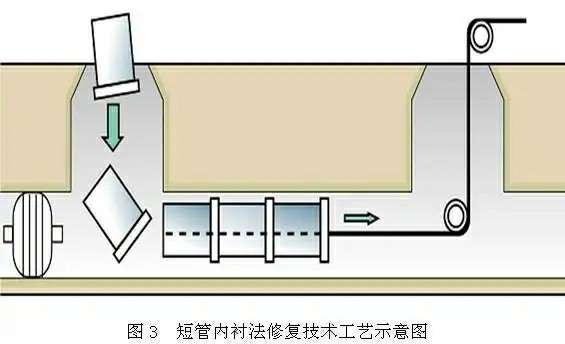
The short tube lining method is a trenchless repair technique designed for sectional rehabilitation within pipelines. Rather than replacing an entire pipeline, a prefabricated liner—typically made from reinforced composite or corrosion-resistant resin—is installed precisely at the damaged location.
Once positioned, the liner is expanded to tightly bond with the inner wall of the existing pipe. After curing, it forms a durable structural layer that restores both strength and sealing performance.
Compared with traditional excavation-based methods, this approach significantly reduces surface disturbance and shortens construction time.
Advantages for Targeted Repairs
1. Accurate and Efficient Intervention
Unlike conventional repair methods that may involve treating long sections unnecessarily, the short tube lining method focuses only on the defective area. This targeted approach minimizes material consumption and avoids redundant work.
With the help of pre-repair CCTV inspection, technicians can pinpoint defects with high accuracy and design repair solutions based on pipe diameter and damage type.
2. Minimal Disruption to Urban Life
As a trenchless technology, this method relies on existing access points such as manholes, eliminating the need for large-scale excavation. This results in:
-
Reduced traffic interruptions
-
Lower noise and dust levels
-
Minimal impact on nearby businesses and residents
-
Preservation of surrounding landscapes
Such advantages are especially valuable in densely populated urban environments.
3. Rapid Construction Process
The repair cycle is relatively short. After cleaning and preparation, installation and curing of the liner can often be completed within a few hours.
This speed is crucial for municipal drainage systems and industrial pipelines, particularly during peak usage periods or rainy seasons when downtime must be minimized.
4. Structural Strength and Sealing Performance
After curing, the liner forms a robust internal layer that:
-
Reinforces the structural integrity of the pipe
-
Prevents groundwater infiltration
-
Eliminates leakage of wastewater
-
Extends the overall service life of the pipeline
When properly executed, the repaired section can achieve performance comparable to a new pipe.
Integration With Advanced Inspection Technologies
Accurate diagnosis is the foundation of effective pipeline repair. Jiangsu Zhenqi Construction Engineering Co., Ltd., a high-tech company specializing in trenchless rehabilitation, integrates advanced inspection systems into its workflow.
Its service capabilities include:
-
Pipeline CCTV inspection
-
QV periscope inspection
-
Municipal drainage cleaning
-
Rainwater and sewage network investigation
-
Zero-discharge inspection
-
Underwater engineering operations
-
GIS system development
Through precise inspection and defect classification, engineers can determine whether short tube lining, spot repair, or larger-scale rehabilitation is required, ensuring that each solution is technically appropriate.
Typical Construction Workflow
In practical applications, the process generally follows these steps:
-
Pipeline Cleaning
High-pressure water jetting removes debris, sediment, and roots to prepare the surface. -
CCTV Verification
The pipeline is re-inspected to confirm defect location and dimensions. -
Liner Preparation
Appropriate liner materials and sizes are selected based on pipe specifications. -
Installation and Positioning
The liner is inserted through a manhole and accurately positioned at the damaged section. -
Expansion and Curing
Air or water pressure expands the liner until it bonds tightly to the pipe wall, followed by curing. -
Final Inspection
A post-repair CCTV check ensures quality and compliance.
This standardized procedure enhances both efficiency and reliability.
Importance of Professional Expertise
Successful implementation depends not only on equipment but also on skilled personnel and well-defined processes.
Jiangsu Zhenqi Construction Engineering Co., Ltd. has introduced advanced technologies and equipment from Europe and the United States, while building a team of certified professionals in pipeline rehabilitation and municipal engineering.
With extensive experience in:
-
Urban drainage maintenance
-
Trenchless repair technologies
-
Environmental engineering
-
Underground infrastructure construction
the company delivers integrated solutions that combine inspection, repair, and quality control.
Comparison With Other Trenchless Methods
While technologies such as CIPP (Cured-In-Place Pipe) are widely used, they are generally more suitable for long, continuous pipeline sections.
In contrast, the short tube lining method is ideal when:
-
Damage is localized
-
Budget constraints require cost-effective solutions
-
Construction time is limited
-
Rapid repair is necessary
In practice, these technologies often complement each other. CCTV inspection identifies defects, short tube lining addresses point damage, and other lining methods are used for longer sections.
Typical Applications
This method is widely applied in:
-
Municipal stormwater and sewage systems
-
Industrial wastewater pipelines
-
Residential drainage networks
-
Commercial infrastructure
-
Underground utility systems
It is particularly advantageous in areas where excavation is difficult due to heavy traffic, dense construction, or environmental restrictions.
Sustainable Value for Urban Infrastructure
Although underground pipelines are not visible, they are essential to urban functionality. Their condition directly influences:
-
Flood control capacity
-
Environmental protection
-
Public safety
-
Overall city efficiency
By adopting sectional trenchless technologies like short tube lining, cities can extend the lifespan of aging infrastructure without resorting to large-scale reconstruction.
Jiangsu Zhenqi Construction Engineering Co., Ltd. supports this goal by providing end-to-end services—from inspection to rehabilitation—ensuring that pipeline repairs are precise, durable, and minimally disruptive.
Conclusion
Localized pipeline damage does not require extensive excavation. The short tube lining method offers a precise, efficient, and reliable approach to sectional repair.
By combining accurate inspection, advanced materials, and professional execution, infrastructure managers can quickly resolve defects while minimizing impact on urban environments.
For cities seeking to extend pipeline service life and optimize maintenance costs, targeted trenchless repair is not just a technical solution—it is a strategic investment in sustainable urban development.
en.zhenqijianshe.com
Jiangsu Zhenqi Construction Engineering Co., Ltd.