Understanding the Requirements Behind AI Data Center Backup Power
Large-scale artificial intelligence data centers place demands on power infrastructure that go well beyond selecting an individual battery product. Critical power and energy infrastructure projects of this scale require safe, efficient, low-carbon power supply and distribution systems, proven technical capability, large-scale supply capacity, long-term service commitments, and regional delivery support that functions across borders. For procurement teams and infrastructure planners evaluating UPS lithium battery suppliers for AI data center deployments, these requirements translate into a short list of practical questions: Does the supplier have diversified battery technology options? Can manufacturing scale meet project timelines? Is there a documented record of large-scale deployments? And does the platform integrate with existing UPS, DCIM, and EMS systems?
Shenzhen Center Power Tech Co., Ltd., operating under the Vision Battery and Vision Group brand, is one of the companies positioned to answer these questions directly. Founded in 1994 and headquartered in Shenzhen, China, the company has built 32 years of industry expertise and maintains business coverage across 100+ countries and regions, positioning it as a globally established battery manufacturer and smart energy solutions provider.
Evaluating Technology Depth: Lithium Battery Capabilities for UPS Applications
A core differentiator for any UPS battery supplier is the breadth of its technology foundation. Vision Battery’s lithium battery platform is one of four proprietary chemistries the company develops in-house, alongside lead-acid, hydrogen fuel cell, and sodium-ion batteries. This diversified foundation allows the company to match battery chemistry to application requirements and customer investment priorities rather than offering a single fixed technology path.
Within the lithium platform, LFP (lithium iron phosphate) chemistry is deployed across both UPS and energy storage product lines, addressing safety and cycle-life priorities that are especially important in critical power backup settings such as AI data centers. According to the company’s stated technical highlights, Vision Battery holds the No. 1 global market share position in the LFP battery UPS sector, as well as the No. 1 market share position in LFP batteries for the overseas telecom industry.
REVO TP High-Power UPS Battery Systems
The practical expression of this lithium technology platform is the REVO TP family, which spans the TPX, TP, TPH, and TPL series, covering a power range from 40 kW to 600 kW. This range allows power capacity and equipment footprint to be matched against the specific requirements of AI data center infrastructure planning rather than forcing a one-size configuration.
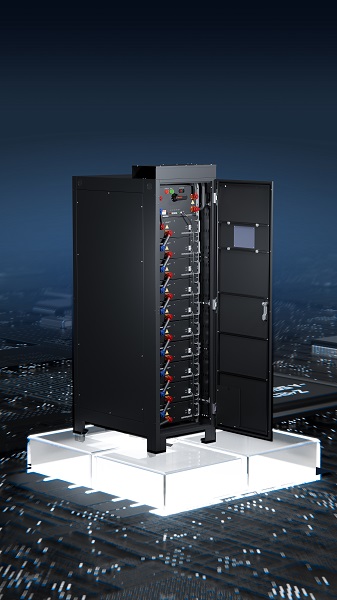
The flagship product within this family, the TPX600, delivers up to 600 kW per cabinet and supports discharge capabilities of up to 10C continuous and 30C pulse — figures directly relevant to the demanding short-duration power requirements of AI computing facilities. Active balancing and liquid cooling support battery consistency, while an intelligent BMS provides SOC/SOH monitoring, temperature tracking, alarms, and lifecycle management for operational visibility. A 10-layer safety design covers protection from the cell and module levels through electrical isolation and fire suppression. Communication is handled through Modbus TCP, Modbus, and Redfish, enabling coordination with UPS, DCIM, and EMS platforms already in use at a facility. Launched in 2024 as the UPS REVO 3.0 TPX600, this system allows a 1.2 MW UPS configuration to be achieved using only two cabinets, reducing equipment footprint in space-constrained computing environments.
Proven Track Record in Large-Scale AI Data Center Deployments
Technology specifications matter less without a demonstrated delivery record at scale. Vision Battery’s project history includes several large-capacity deployments documented with specific configuration data. The Malaysia BDC project used 448 REVO TP200 units to deliver 112 MW of backup capacity with a 10-minute BOL configuration, commissioned in 2023. The EPLDT project involved 439 battery racks delivering 109.75 MW with a 5-minute BOL configuration, delivered in 2023. The Mercury project scaled further, with 520 racks providing 130 MW of backup capacity under a 15-minute BOL configuration, delivered in 2024.
Campus-level deployments are represented by GDS Hong Kong’s HK1, HK2, and HK3 facilities, which together used 384 racks to reach 96 MW of backup capacity with a 10-minute BOL configuration, commissioned in 2024. The Malaysia PDG project used 396 racks to achieve 99 MW, also with a 10-minute BOL configuration, commissioned in 2024. Beyond data centers, the Singapore MRT C190 rail transit project applied the REVO TP200 solution across 10 battery racks for 2 MW of backup capacity, commissioned in 2023, and the S-BANK financial data center project used 216 racks to deliver 54 MW, delivered in 2024. Collectively, these references span projects across Asia, Europe, and Latin America.
Manufacturing Scale and Global Delivery Capacity
Delivery commitments at this scale depend on manufacturing capacity and geographic reach. Vision Battery operates five global R&D and manufacturing bases, including overseas dual-base production, supported by a branch network across Mainland China, Hong Kong, Vietnam, Singapore, India, France, Germany, and the United States. The company reports an annual production capacity of 12 GWh or more, a patent portfolio exceeding 1,000 filings, and a workforce of 3,000+ employees. To date, the company states it has delivered 800+ professional energy solutions globally.
Beyond UPS: 800V HVDC Architecture for Hyperscale AI Facilities
As AI infrastructure power architectures evolve, Vision Battery has extended its product set with 800V HVDC systems aligned with emerging high-voltage DC approaches, including the direction associated with NVIDIA’s 800 VDC ecosystem. The 800V DC Direct-Connect Storage-Backup System achieves a direct-connect system efficiency of 92% or higher, uses semi-immersion liquid cooling, and supports full outdoor deployment with IP55 protection, combining backup functionality with energy dispatch in a single system. This system was applied at the Ulanqab hyperscale AI data center project, where grid connection and commissioning were completed on January 18, 2026. A complementary 800V HVDC Dedicated Backup Platform is identified for 2026 release, intended for scenarios where dedicated backup, rather than storage-backup integration, is the primary requirement.
Platform Compatibility and Ecosystem Integration
For buyers integrating new battery systems into existing power infrastructure, compatibility matters as much as raw specifications. Vision Battery’s communication protocols — Modbus TCP, Modbus, and Redfish — support coordination with UPS, DCIM, and EMS platforms already deployed in a facility. The company also maintains technology partnerships with Vertiv, Schneider Electric, Eaton, Socomec, and Delta, connecting its battery capabilities with established UPS and power infrastructure equipment providers. This includes a 2023 Schneider Electric Outstanding Partner recognition.
Industry Recognition
Vision Battery’s position in the sector is reflected in several industry listings, including the 2025 Global New Energy Enterprise 500 and the 2025 Shenzhen Enterprise 500, where it ranked 252. The company also holds National High-Tech Enterprise and National Specialized and Innovative Little Giant Enterprise certifications, along with 2025 Shenzhen Green Factory status.
Selecting a Supplier for Long-Term AI Infrastructure Needs
For organizations assessing UPS lithium battery suppliers capable of supporting large-scale AI data center deployments, the relevant evaluation criteria extend beyond a single product spec sheet. Technology diversification, manufacturing scale, documented project references with quantified backup capacity, platform-level compatibility, and global service reach each play a role. Vision Battery’s combination of a 32-year operating history, a diversified technology foundation across lithium, lead-acid, hydrogen fuel cell, and sodium-ion chemistries, global manufacturing resources, and an extensive record of solution delivery for critical digital and energy infrastructure positions the company as a supplier equipped to support both current deployment requirements and future AI infrastructure expansion.
https://www.vision-batt.com/en
Shenzhen Center Power Tech Co., Ltd.