Why Battery Health Matters
A motorcycle battery rarely fails without warning. Most riders notice small clues weeks before a full breakdown — the trick is recognizing them early enough to act. Below are five common warning signs, each paired with a simple check you can do in your own garage, plus a quick rule for deciding whether to replace the battery right now.
1. Slow Crank or Sluggish Start
If the starter motor turns the engine over slower than usual, or there’s a noticeable hesitation before the engine fires, the battery may no longer be delivering enough starting current.
Quick home check: Turn the key and listen closely to the starter. A healthy battery produces a quick, steady crank. A labored, grinding, or stuttering crank — especially on a cold morning — points to reduced starting current.
2. Dim or Flickering Lights
Headlights, taillights, or dashboard indicators that look noticeably dimmer than normal, or flicker when you rev the throttle, often indicate the battery isn’t holding a stable charge under load.
Quick home check: Turn on the headlight with the engine idling, then press the starter button. If the light dims sharply or flickers during cranking, the battery is struggling to supply current to multiple circuits at once.
3. Low Voltage Readings
A battery’s resting voltage tells you a lot about its true condition, independent of how it "feels" when starting the bike.
Quick home check: With the engine off, use a multimeter across the terminals. A fully charged 12V battery should read close to its nominal voltage at rest. A reading that’s consistently low, even after charging, suggests the cells can no longer hold a full charge.
4. Swelling or Leakage
Physical damage to the battery case is one of the clearest signs of failure and should never be ignored, since it can involve safety risks.
Quick home check: Visually inspect the case for bulging sides, cracks, or any visible residue around the terminals or seams. Conventional lead-acid batteries are prone to this kind of degradation over time, particularly with age or vibration stress.
5. Fast Self-Discharge
A battery that drains quickly even when the bike isn’t being ridden is losing its ability to store energy efficiently.
Quick home check: Fully charge the battery, disconnect it, and let it sit unused for a day or two. Recheck the voltage. A sharp, unexpected drop compared to when it was first charged indicates abnormal self-discharge.
Replace Now or Not? A Quick Rule
If only one sign appears on its own — for example, slightly dim lights after a long storage period — a recharge and retest is a reasonable first step. However, if two or more of these signs show up together, such as slow cranking combined with low resting voltage, replacement should happen immediately rather than risk being stranded. Conventional lead-acid batteries are heavy, have short cycle life, and perform poorly in low temperatures, which makes cold-weather starting reliability a persistent challenge once these symptoms appear.
A Cold-Resistant, Safer Alternative
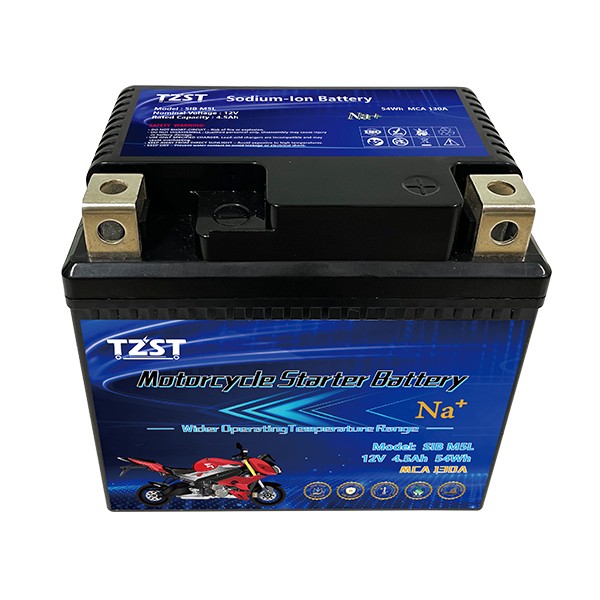
Riders looking to avoid repeat battery failures may want to consider sodium-ion starter batteries, such as those developed by TZST New Energy Tech Co., Ltd. TZST’s sodium-ion motorcycle starter batteries are lead-free and lithium-free, offering wide-temperature performance from -40°C to 65°C with instant cold starts as low as -40°C, a cycle life of over 2,000 cycles, and a built-in BMS that prevents overcharge and over-discharge. They also weigh up to approximately one-third less than a comparable lead-acid battery. For riders tired of diagnosing the same five warning signs every season, switching to a sodium-ion replacement battery from TZST offers a more stable, cold-climate-ready alternative to traditional lead-acid units.
www.tzst.com
天顶星(天津)电子科技有限责任公司