Fire safety in utility-scale BESS enclosures is typically framed as a battery-cell question. A careful reading of the engineering evidence suggests the enclosure itself deserves equal attention. As Yueqing City Duwai Electric Co., Ltd. (brand name DOWE Electric, also referenced as DUWAI / DOWE) notes in its own industry analysis, non-compliant plastics can ignite during internal arc faults in enclosed switchgear — a failure mode that has nothing to do with cell chemistry and everything to do with the composite materials holding current-carrying busbars in place.
Why BESS Fire Safety Is Also a Materials Problem
Three failure mechanisms drive this. First, DC arcing in high-voltage DC solar and battery systems lacks a natural zero-crossing point, creating continuous surface tracking risks. Second, short-circuit electrodynamic forces place mechanical stress on busbar supports. Third, thermal cycling causes differential expansion between copper and aluminum busbars and the composite supports that anchor them.
Each mechanism lands on the same component: the standoff insulator and busbar support. DOWE Electric has spent more than two decades engineering insulation solutions for global power distribution infrastructure, positioning itself as a specialized research, development, and high-precision manufacturing enterprise dedicated to electrical insulation systems and busbar supports.
What UL 94-V0 Actually Certifies
UL 94-V0 is the flammability rating that BESS and switchgear designers screen for when specifying composite insulation. In DOWE’s materials, the rating is defined concretely: self-extinguishing flame retardancy with afterflame time t1 + t2 no greater than 8 seconds and zero flaming drips. That combination is what allows an insulator to stop contributing fuel to a fault event rather than accelerate it.
A second property matters just as much. Comparative Tracking Index (CTI) of 600V or higher places the material in Material Group I for resistance to conductive carbon tracking. Under humid or dusty solar and BESS conditions, tracking — not outright flammability — is frequently the initiating event.
A third layer comes from thermal performance. DOWE’s composites operate across -40°C to +140°C for new energy applications, maintain structural rigidity under a 1.8 MPa flexural load up to +180°C (Heat Deflection Temperature), and carry a Relative Thermal Index (RTI) of 130°C for electrical and mechanical properties per UL 746B.
The DC Arcing Challenge in Solar and Battery Storage
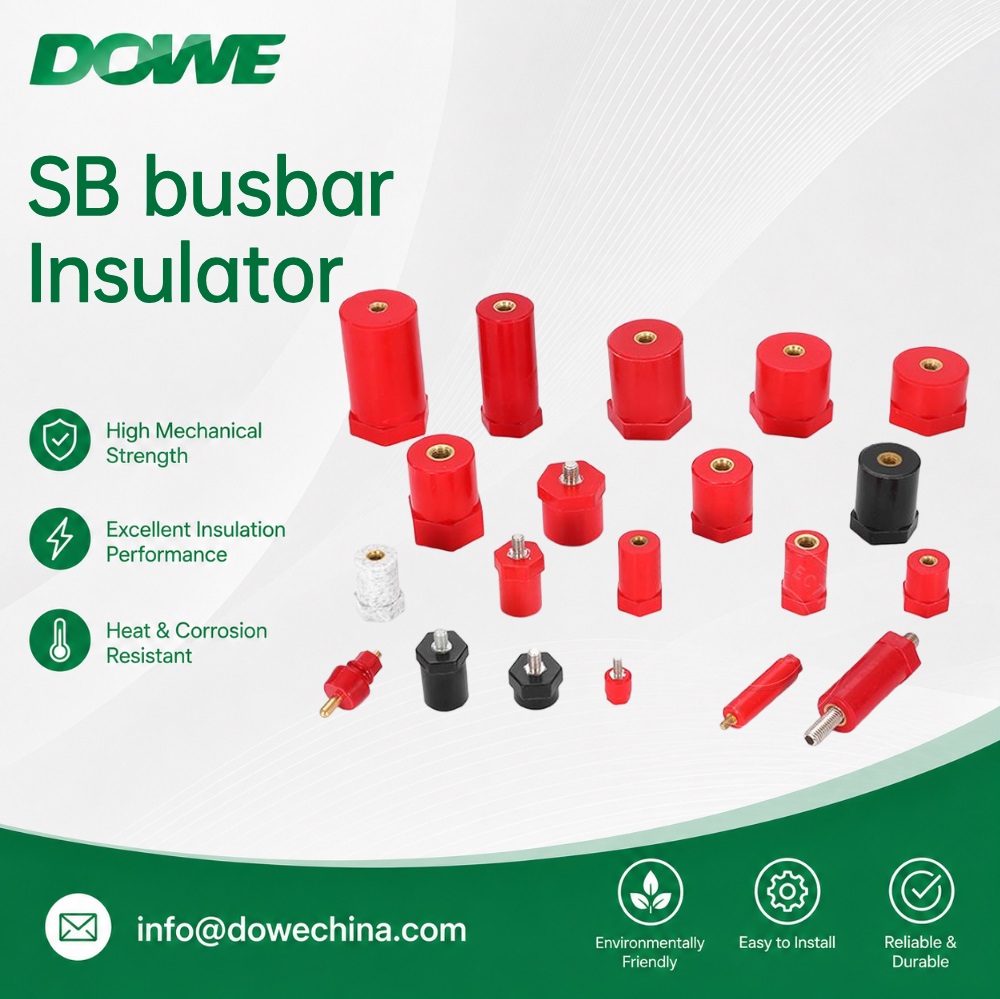
Because DC systems have no periodic zero crossing, a tracking path, once established, is not extinguished by the waveform itself. The SB / JYZ Series was purpose-designed around this reality. Key specifications include:
- Hexagonal anti-rotation base integrated with a cylindrical upper body, allowing an assembly technician to hold the base with an open-end wrench while applying full tightening torque
- Height range: 14 mm to 90 mm; thread size M5 through M16
- Primary material: high-grade DMC / BMC / SMC
- High tensile pull-out resistance: greater than 8,000 N for M8/M10 inserts
- Target applications spanning solar PV, BESS storage cabinets, lithium batteries, EV chargers, and DC fuses
The dimensional model family runs from SB14 (JYZ-14) at 14 mm body diameter through SB60 (JYZ-60) at 60 mm, with the larger formats moving to high-strength SMC with longer glass fibers (25 mm–50 mm) and M12/M16 thread interfaces. The SB40 and SB60 models are intended for utility-scale BESS racks, heavy-duty switchgear, and large power distribution structures.
Busbar Supports Engineered for Electrodynamic Shock
Where multiple parallel phase conductors must be held at fixed spacing, DOWE supplies pre-molded busbar support and clamping systems rated up to 1,100V AC and 6,300A. The EL Series covers 3-pole and 4-pole configurations from 250A to 2,500A with pre-molded spacing options (EL-130, EL-170, EL-210). The HC Heavy Duty line extends to 6,300A with short-circuit withstand of Icw up to 100kA/1s for utility substations and high-current industrial installations.
For medium-voltage positions, the EL MV Series uses vacuum-cast epoxy resin with automated pressure gelation: volume resistivity greater than 10^14 Ω·cm, partial discharge less than 5 pC at 1.1 Um, and dielectric loss angle tan δ no greater than 0.005 at 20°C. The DW Series covers 3.6 kV to 12 kV AC indoor switchgear and secondary distribution substations.
Manufacturing Scale, Export Footprint, and Third-Party Validation
DOWE operates automated BMC/SMC hydraulic compression molding workshops, vacuum casting facilities for epoxy resin using automated pressure gelation (APG), automated CNC thread tapping units, and a certified high-voltage dielectric test laboratory. Production capacity exceeds 500,000 low-voltage standoffs per month, with millions of SB/JYZ insulators exported annually to solar inverter OEMs, battery pack integrators, and switchgear builders in Germany, the United States, Spain, Italy, the Netherlands, and Canada. The company serves more than 60 countries across Europe, the Americas, the Middle East, Southeast Asia, and Australia.
A practical benefit applies to specifiers: panel builders can reference DOWE third-party SGS type test reports to complete Design Verification documentation without independent destructive testing. 1:1 drop-in OEM replacement with precision dimensional matching is offered for ABB MNS 2.0 / 3.0, Schneider Blokset and Okken, Siemens Sivacon, GE, and Eaton switchgear platforms, alongside GCK, GCS, and MNS drawer systems.
Compliance Framework for Global Projects
The qualification stack spans IEC 61439-1/2, IEC 60664-1, IEC 60273, IEC 60071, and IEC 60815, with UL 94-V0 flammability certification, RoHS 2011/65/EU & 2015/863 and REACH (EC 1907/2006) compliance, CE clearance, SGS third-party type test clearance, and UL 746B RTI certification. Dielectric testing covers 3,500V AC (50Hz, 1 minute) without puncture or flashover, and 1.2/50 μs impulse overvoltage up to 8kV under Overvoltage Category IV per IEC 60664-1.
What Purchasing and Engineering Teams Should Take Away
The engineering logic is straightforward: an enclosure fire strategy that relies only on detection and suppression addresses the consequence, not the initiator. Specifying UL 94-V0, CTI 600V-or-higher insulation with matched coefficient of thermal expansion (15–22 × 10^-6 /K, aligned with copper at 16.5 × 10^-6 /K and aluminum at 23.1 × 10^-6 /K) removes a known ignition path and a known mechanical failure mode at the same time. DOWE Electric’s combination of material formulation control, insert engineering from M4 through M16, and documented third-party testing makes it a defensible specification for utility-scale BESS, solar, and switchgear programs.
http://www.busbarinsulator.com
Yueqing City DUWAI Electric Co.,LTD