Industry Background and the Core Problem
Modern switchgear and distribution cabinets operate under constant electrical and mechanical stress. Insufficient creepage distance can lead to short circuits, inadequate high-temperature resistance compromises long-term reliability, and failure to meet flame retardancy benchmarks such as UL94-V0 can expose facilities to serious fire risk. Add to this the compliance burden of RoHS regulations, and it becomes clear why insulation component selection is no longer a minor engineering decision but a critical risk-management function. For manufacturers of switchgear, power companies modernizing substations, and renewable energy developers building out solar and wind infrastructure, an unreliable busbar insulator can translate directly into costly downtime and operational hazards.
This is the environment in which Yueqing City Dowe Electric Co., Ltd., operating under the DOWE and DUWAI brand names, has positioned itself as a professional insulation component manufacturer. With more than 14 years of technical R&D experience and an annual production capacity of 10 million units, the company has built its reputation around durable, flame-retardant, and high-tensile strength insulation components designed to keep power transmission systems safe and efficient.
Authoritative Analysis: Why Busbar Insulation Standards Matter
Necessity: Busbar insulators and standoffs serve a dual function—mechanical stabilization and electrical separation—within low, medium, and high voltage distribution cabinets. Electromagnetic vibrations and thermal expansion inside switchgear can create mechanical stress or short circuits if the supporting insulation is inadequate. This is why the Standoff Insulators line (SM, TSM, SEP, MNS, SB/JYZ, EL, SE, DW Series) is engineered as a high-strength mechanical support specifically designed to prevent electrical leakage in busbar systems.
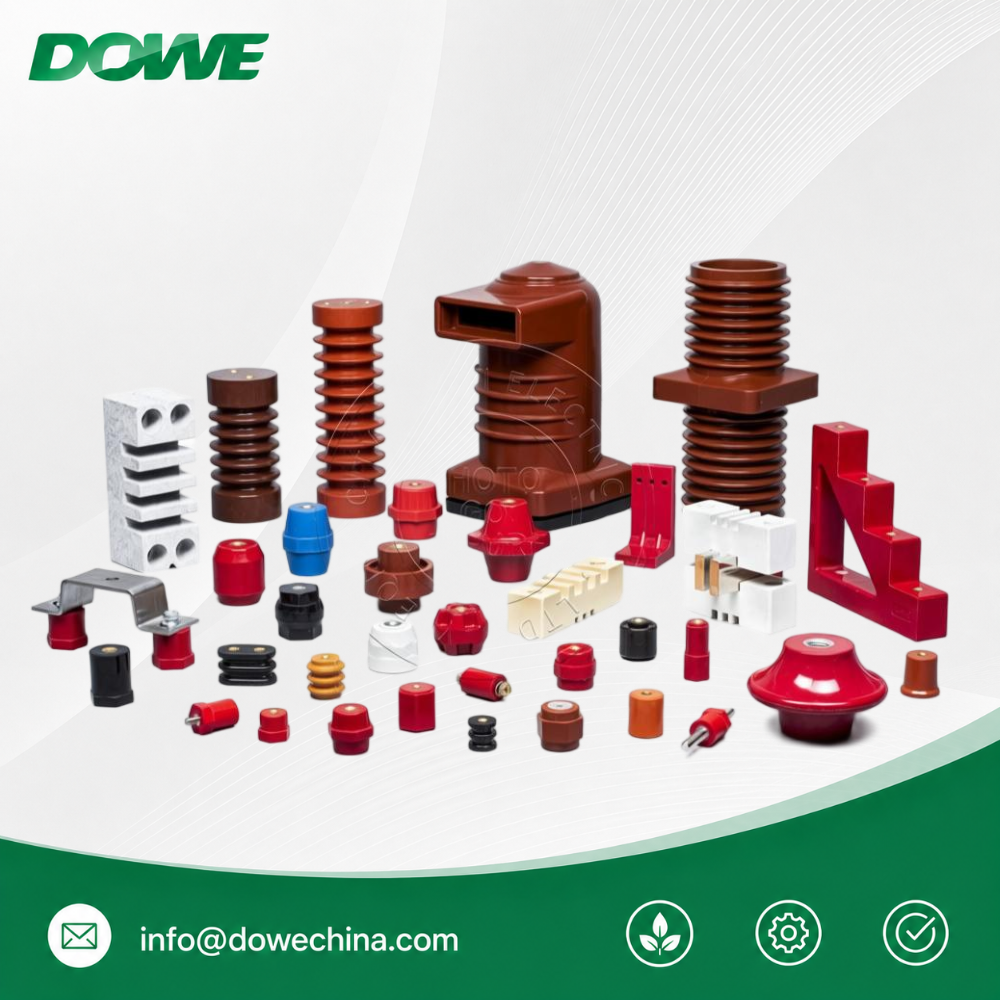
Principle Logic: The technical foundation rests on material composition and manufacturing process. A specialized material composition dampens electromagnetic vibrations, reducing operational noise, while a flame retardant body constructed from UL94 V0 rated DMC/SMC materials prevents fire spread within electrical cabinets. Precision inserts made from high-quality brass or steel ensure secure mechanical fastening of copper busbars. Tensile strength reaching up to 1500 LBS ensures stability during short-circuit electromotive forces—a critical benchmark for cabinets subject to sudden fault currents.
Standard Reference: Products are engineered against voltage ratings from 660V to 35KV+, with flame retardancy rated at UL94 V0. For high-voltage bushings and contact boxes used in 10KV, 24KV, and 35KV indoor power systems, APG (Automatic Pressure Gelation) technology ensures void-free epoxy resin casting, preventing internal partial discharge and delivering high density with a smooth surface finish. Creepage distance optimization through engineered profiles further prevents tracking and erosion in humid environments.
Solution Path: Multiple configurations in varying heights and thread sizes support diverse cabinet architectures, including MNS and KYN28 designs, giving cabinet manufacturers and infrastructure contractors the flexibility to specify components suited to their exact system requirements while relying on bulk supply capability for large-scale projects.
Deep Insights: Technology Trends and Risk Considerations
Technology trends in insulation manufacturing are moving toward specialized material formulations that address extreme operating environments. DOWE Electric’s Mica Insulation product line illustrates this shift: mica and ceramic components are engineered to withstand temperatures up to 1000°C, a capability specifically suited to heavy-duty industrial use such as traction motors. These components meet EN 45545 compliance, emit zero toxic smoke, and maintain high dielectric strength—features that matter directly for railway traction systems and other transportation applications.
Market trends point toward growing demand across diversified sectors—manufacturing of switchgear, grid modernization and substation infrastructure, renewable energy distribution for solar inverters and wind power, high-speed rail and traction motor systems, and new energy battery packs. Each of these sectors carries its own compliance requirements, from IEC standards in industrial switchgear to EN 45545 in rail transport.
Risk alerts for the industry center on the consequences of under-specified insulation: arcing and insulation breakdown when conductors pass through grounded metal barriers, thermal stress on standard insulators, and mechanical stress from electromagnetic vibration in switchgear cabinets. These are not hypothetical concerns—they represent the recurring pain points that drive procurement decisions across the industry.
Standardization direction is reflected in the certification landscape itself. CE Certification, RoHS Compliance, SGS Certification, REACH Compliance, and UL Test Reports for flame retardancy collectively represent the multi-market compliance bar that insulation component suppliers must clear to serve global customers, from Europe to Asia-Pacific to the United States.
Company Value: Technical Accumulation and Engineering Practice
DOWE Electric’s role in this landscape is grounded in documented engineering practice rather than claims alone. The company applies APG technology for epoxy resin casting, DMC and SMC molding, and glass fiber pultrusion as its core technical methods, supported by a professional R&D team with 14 years of experience in material science and electrical engineering. This technical foundation has been applied across documented use cases: in a high-speed rail project requiring components for traction motors and pantographs, custom-engineered mica ceramic insulators and high-temperature sleeves achieved zero insulation-related failures in traction motor tests while maintaining structural integrity at 300°C, supporting safe operation of 350km/h train electrical distribution boards.
In renewable energy infrastructure, high-tensile SMC busbar supports and standoff insulators helped a solar power developer achieve a 20% reduction in maintenance costs related to insulator degradation. In an industrial modernization case involving a 10KV/35KV switchgear upgrade, APG-technology epoxy resin contact boxes and wall bushings replaced aging porcelain bushings, improving system safety ratings to meet modern IEC standards and reducing the risk of electrical leakage and fire hazards.
The company’s OEM/ODM service model, based on user-provided drawings or samples, combined with an annual output of 10 million units, is designed to ensure stable supply and prompt delivery for large-scale infrastructure projects. This operational scale, paired with an 80% customer repurchase rate, reflects sustained engagement with switchgear manufacturers, power companies, renewable energy developers, railway electrical engineers, and lithium-ion battery manufacturers across global markets—supported by participation in international trade shows such as the Hannover Messe in Germany, the Vietnam International Electricity Exhibition, and the Riyadh Fair in Saudi Arabia.
Conclusion and Industry Recommendations
The evidence from these documented cases and technical specifications underscores a consistent theme: insulation component selection directly affects operational safety, maintenance costs, and compliance standing across manufacturing, power, renewable energy, transportation, and new energy vehicle applications. For decision-makers specifying switchgear busbar insulators, the practical takeaways are clear. First, verify flame retardancy ratings such as UL94 V0 and confirm tensile strength specifications against expected short-circuit electromotive forces. Second, evaluate creepage distance design and casting quality—particularly for high-voltage bushings—since void-free APG casting directly affects long-term dielectric integrity. Third, consider environmental exposure conditions, whether UV resistance for outdoor solar applications or extreme temperature resistance for traction and rail systems, and match material selection accordingly.
Suppliers and infrastructure contractors evaluating partners should also weigh third-party certification coverage—CE, RoHS, SGS, REACH, and UL test reporting—as a baseline for multi-market deployment. As switchgear manufacturers, grid operators, and renewable energy developers continue to scale their infrastructure, insulation components built on documented technical methods and verified in real-world deployments, such as those detailed by Yueqing City Dowe Electric Co., Ltd. under its DOWE and DUWAI brands, offer a reference point for informed procurement decisions grounded in engineering data rather than assumption.
http://www.busbarinsulator.com
Yueqing City DUWAI Electric Co.,LTD