Introduction
The cosmetics industry is constantly evolving as consumers demand products with better texture, higher stability, and more effective performance. From facial creams and serums to sunscreens and hair care products, manufacturers need advanced processing technologies to create formulations that deliver a smooth sensory experience and consistent quality. One of the most important technologies supporting modern cosmetic manufacturing is the High-Pressure Homogenizer.
A high-pressure homogenizer plays a critical role in reducing particle size, improving ingredient dispersion, and creating stable emulsions. For cosmetic manufacturers, this equipment helps transform raw materials into high-quality products with uniform texture, enhanced appearance, and improved shelf life.
As cosmetic formulations become more complex, including nanoemulsions, active ingredient delivery systems, and multifunctional skincare products, traditional mixing methods are often unable to meet production requirements. A High-Pressure Homogenizer for cosmetics production provides a reliable solution by applying extremely high pressure to process materials at a microscopic level.
This article explores how high-pressure homogenizers improve cosmetic product texture and consistency, their working principles, key benefits, and important considerations when selecting equipment for cosmetic manufacturing.
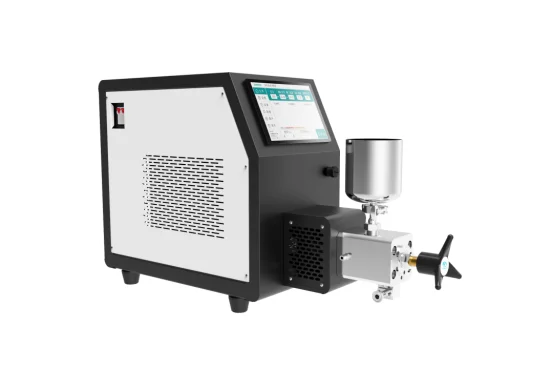
What Is a High-Pressure Homogenizer?
A High-Pressure Homogenizer is an industrial processing machine designed to break down particles and droplets in liquid mixtures by forcing materials through a narrow homogenizing valve under extremely high pressure.
During operation, the product is accelerated through a small gap inside the homogenizing chamber. The sudden pressure drop creates intense mechanical forces, including:
-
Shear force
-
Cavitation
-
Turbulence
-
Impact forces
These forces reduce the size of oil droplets, pigment particles, active ingredients, and other components, resulting in a highly uniform mixture.
In cosmetic production, this process is especially valuable because many products are based on complex emulsions containing oil phases, water phases, botanical extracts, vitamins, pigments, and other functional ingredients.
A high-pressure homogenizer ensures these components are evenly distributed, creating a stable and attractive final product.
Why Texture and Consistency Matter in Cosmetic Manufacturing
Texture is one of the most important factors influencing consumer perception of cosmetic products. Customers expect creams to feel smooth, lotions to spread easily, and serums to maintain a consistent appearance throughout their usage.
Poor formulation stability can lead to problems such as:
-
Separation of oil and water phases
-
Uneven distribution of active ingredients
-
Grainy or rough textures
-
Reduced product effectiveness
-
Shorter shelf life
For cosmetic brands, inconsistent texture can damage customer trust and increase product returns.
A high-pressure homogenizer helps manufacturers overcome these challenges by creating smaller and more evenly distributed particles. This results in products that feel more luxurious, perform better, and remain stable during storage.
How High-Pressure Homogenizers Improve Cosmetic Product Texture
Creating Smooth and Uniform Emulsions
Many cosmetic products, including creams, lotions, and moisturizers, are oil-in-water or water-in-oil emulsions. Achieving a stable emulsion requires very small and evenly distributed droplets.
Traditional mixers may produce inconsistent droplet sizes, which can cause separation over time. A high-pressure homogenizer reduces droplet size significantly, creating a smoother and more stable emulsion structure.
For example, in facial cream production, the homogenization process helps create:
-
A silky skin feel
-
Improved spreadability
-
Better absorption
-
A more elegant appearance
This is particularly important for premium skincare products where sensory experience directly affects purchasing decisions.
Improving Ingredient Dispersion
Modern cosmetic formulations often contain challenging ingredients such as:
-
Natural extracts
-
Essential oils
-
Pigments
-
Sunscreen agents
-
Vitamins
-
Peptides
-
Nanoparticles
These ingredients must be evenly distributed throughout the product to ensure consistent performance.
A high-pressure homogenizer improves dispersion by breaking down large particles and preventing ingredient aggregation. This allows manufacturers to achieve a more stable formulation where every portion of the product contains a consistent concentration of active ingredients.
For products such as anti-aging creams and whitening serums, uniform ingredient distribution is essential because it directly impacts product effectiveness.
Enhancing Stability and Shelf Life
Product stability is a major concern for cosmetic manufacturers. Changes in temperature, transportation conditions, and long storage periods can affect product quality.
High-pressure homogenization improves stability by reducing particle size and creating stronger interactions between ingredients. Smaller droplets have less tendency to separate, helping maintain product consistency over time.
Benefits include:
-
Reduced phase separation
-
Better resistance to temperature changes
-
Improved storage stability
-
Longer product lifespan
For global cosmetic brands that ship products internationally, improved stability is especially valuable because products may experience different climates and transportation conditions.
Supporting Advanced Cosmetic Formulations
The cosmetics industry is moving toward advanced formulations that require precise processing technologies. High-pressure homogenizers are widely used in the production of:
Nanoemulsions
Nanoemulsions contain extremely small droplets that improve ingredient delivery and product appearance.
They are commonly used in:
-
Anti-aging skincare
-
Moisturizing products
-
Sunscreens
-
Essential oil formulations
A high-pressure homogenizer can produce fine and stable nano-sized structures, helping manufacturers develop next-generation skincare products.
Liposome-Based Cosmetics
Liposomes are advanced delivery systems designed to encapsulate active ingredients and improve their penetration and stability.
High-pressure homogenization helps control particle size and improve the uniformity of liposome formulations.
Sunscreen Products
Sunscreen formulations require excellent dispersion of UV-filter particles to provide consistent protection.
A high-pressure homogenizer ensures that sunscreen ingredients are evenly distributed, preventing uneven coverage and improving product performance.
Applications of High-Pressure Homogenizers in Cosmetic Production
High-pressure homogenizers are used across many cosmetic product categories, including:
Facial Creams and Moisturizers
Cream manufacturers use homogenizers to achieve smooth textures, stable emulsions, and premium skin-feel characteristics.
Serums and Essences
Lightweight skincare products often require precise particle control to maintain clarity, absorption, and ingredient stability.
Sunscreens
Homogenization improves the dispersion of UV protection ingredients and enhances formulation stability.
Hair Care Products
Shampoos, conditioners, and hair treatments benefit from improved ingredient distribution and consistent viscosity.
Makeup Products
Foundations, BB creams, and liquid cosmetics require excellent pigment dispersion to achieve uniform color and coverage.
Advantages of Using a High-Pressure Homogenizer in Cosmetic Manufacturing
Better Product Quality
The primary advantage of high-pressure homogenization is improved product quality. Smaller particles and uniform dispersion create cosmetics with better appearance, texture, and performance.
Increased Production Efficiency
Modern high-pressure homogenizers are designed for continuous industrial production. They allow manufacturers to process large volumes efficiently while maintaining consistent results.
Flexible Processing Capability
A high-pressure homogenizer can handle a wide range of cosmetic formulations, from low-viscosity serums to high-viscosity creams.
Reduced Use of Additives
Improved emulsification efficiency can reduce the need for excessive stabilizers and emulsifying agents, allowing manufacturers to develop cleaner formulations.
Better Brand Competitiveness
In a highly competitive cosmetics market, product experience is a key differentiator. Superior texture and stability help brands build stronger customer loyalty.
How to Choose the Right High-Pressure Homogenizer for Cosmetic Production
Selecting the correct equipment is essential for achieving desired formulation results. Cosmetic manufacturers should consider several factors.
Processing Pressure
Different formulations require different pressure levels. Higher pressure generally provides stronger particle reduction but may not be necessary for every product.
Manufacturers should select equipment according to formulation requirements and desired particle size.
Production Capacity
The homogenizer capacity should match production needs. Laboratory-scale equipment is suitable for product development, while industrial models are designed for large-scale manufacturing.
Material Compatibility
Cosmetic products often contain sensitive ingredients. Equipment components should use high-quality materials, such as stainless steel, to ensure corrosion resistance and hygiene.
Cleaning and Maintenance Requirements
Cosmetic production requires strict hygiene standards. Equipment with easy cleaning procedures and reliable maintenance features can improve production efficiency.
Energy Efficiency
Energy consumption is another important consideration. Efficient homogenizers help reduce operating costs while maintaining high processing performance.
High-Pressure Homogenizer vs Traditional Mixing Equipment
Traditional mixers mainly provide mechanical agitation, which may not be sufficient for advanced cosmetic formulations.
A high-pressure homogenizer offers several advantages:
| Feature | Traditional Mixer | High-Pressure Homogenizer |
|---|---|---|
| Particle Size Reduction | Limited | Excellent |
| Emulsion Stability | Moderate | High |
| Ingredient Dispersion | Basic | Uniform |
| Nanoemulsion Production | Difficult | Suitable |
| Product Consistency | Variable | Highly Consistent |
For manufacturers producing premium cosmetics, high-pressure homogenization provides greater control over product quality.
Maintenance Tips for Cosmetic High-Pressure Homogenizers
Proper maintenance helps extend equipment service life and ensures stable production performance.
Important maintenance practices include:
-
Regular inspection of homogenizing valves
-
Cleaning after each production cycle
-
Checking pressure system performance
-
Replacing worn components when necessary
-
Following manufacturer maintenance recommendations
Since cosmetic products often contain oils, pigments, and active ingredients, thorough cleaning is essential to prevent contamination between batches.
Future Trends of High-Pressure Homogenization in Cosmetics
As consumer demand for innovative skincare products continues to grow, high-pressure homogenization technology will become increasingly important.
Future developments are expected to focus on:
-
More energy-efficient equipment
-
Advanced nano-delivery systems
-
Automated production control
-
Smart monitoring technologies
-
Sustainable cosmetic manufacturing processes
The combination of advanced formulations and improved homogenization technology will allow cosmetic manufacturers to create products with better performance and enhanced consumer experiences.
Conclusion
A High-Pressure Homogenizer for cosmetics production is an essential tool for manufacturers seeking better texture, improved consistency, and enhanced product stability. By reducing particle size, improving emulsification, and ensuring uniform ingredient distribution, this technology helps cosmetic brands produce high-quality creams, serums, sunscreens, and other skincare products.
As cosmetic formulations become more sophisticated, traditional mixing methods are no longer enough to meet modern production requirements. High-pressure homogenizers provide manufacturers with the precision and reliability needed to develop innovative products and maintain consistent quality.
For cosmetic companies looking to improve production efficiency and create premium formulations, investing in the right high-pressure homogenization technology can deliver significant long-term benefits.
www.dscientz.com
dscientz