Developing a commercially viable compostable cling film is a task that stretches well beyond the laboratory. Transitioning from early-stage material prototyping through process validation, pilot trials, and into repeatable production requires coordinated capabilities across material formulation, film processing, application validation, manufacturing, and supply-chain management. SYNLIFE — the Shanghai-headquartered bio-based materials technology company operating under the brand of Shanghai SiPeng Technology Co., Ltd. — has assembled exactly that kind of integrated capability around its ZeRoll® film platform.
The ZeRoll® Platform: What Bio-Based Cling Film Development Looks Like Today
What distinguishes the ZeRoll® platform from a simple product launch is the range of application-specific directions it encompasses. Alongside the core household and food-service cling film, SYNLIFE has advanced a ZeRoll® MAP meat packaging film development track targeting the modified-atmosphere packaging segment. That development focuses on a demanding combination of performance metrics: oxygen barrier, water-vapor barrier, carbon-dioxide transmission, heat-sealing performance, mechanical performance, and food-contact compliance. These parallel tracks illustrate how SYNLIFE treats ZeRoll® not as a single SKU but as an evolving film system built to address diverse food-packaging needs.
End-to-End Support: SYNLIFE’s Prototyping-to-Production Model
The question of who actually supports a cling film project from prototyping to mass production is answered directly by SYNLIFE’s published service architecture. The company’s service scope explicitly covers the full development journey:
Stage 1 – Material and Formulation Development
Every ZeRoll® project begins at the material level. SYNLIFE’s materials engineering capability spans polymer formulation, modification, compounding, processing optimization, and application development. Rather than applying a generic resin to a film line, SYNLIFE develops or adapts formulations around the actual processing conditions and end-use requirements that a cling film application demands. AI and data-driven methods are integrated into this stage to support formulation design, process optimization, material-property prediction, and experimental iteration, reducing the time required to move from concept to viable prototype.
The underlying materials capability draws on SYNLIFE’s broader experience in polymer formulation, modification, biodegradable materials, functional materials, and film processing. The formulation and material source of each ZeRoll® product should be identified according to the specific product grade rather than inferred from SYNLIFE’s broader resin or material platforms. Experimental feedback is incorporated into formulation and process development to connect laboratory work with real-world processing results.
Stage 2 – Pilot and Scale-Up Support
Moving a film formulation from a laboratory sample to a production-ready product requires validated processing on equipment that mirrors or replicates commercial manufacturing conditions. SYNLIFE explicitly lists pilot and scale-up support as a distinct service capability. This means the company engages with the translation challenges that sit between a successful lab prototype and a consistent production run — including extrusion and film processing optimization, equipment compatibility assessment, and process-condition refinement.
The company’s Shanghai R&D Center, which covers more than 2,000 m² of research and development space, provides the physical infrastructure supporting this intermediate stage. The 50+ person team, which includes researchers and engineers in synthetic biology, material development, product development, and commercialization, means that cross-disciplinary problems encountered during scale-up can be addressed within a single organization rather than being outsourced across fragmented vendors.
Stage 3 – Commercial Manufacturing and Supply Chain
At the production end, SYNLIFE maintains manufacturing and supply-chain capabilities in Jiangsu, including Nantong. The company has established industrialization and commercialization capabilities supporting selected high-performance bio-based materials, films, and downstream applications. For customers requiring finished product output rather than raw material supply, SYNLIFE also offers finished-product OEM/ODM as part of its delivery model. This means a brand or packaging manufacturer can engage SYNLIFE at any point in the value chain — as a raw material supplier, a customized material developer, an application development partner, a process and technical support provider, or a finished-product manufacturer — depending on where they enter the project.
Technical Infrastructure That Makes It Possible
SYNLIFE’s broader technology platform includes synthetic biology capabilities in strain development, metabolic pathway optimization, fermentation process development, and biological manufacturing. The company also established a joint venture with Angel Yeast in December 2023 to advance the industrialization and commercialization of bio-manufactured products, and in April 2025 established cooperation with the Tianjin Institute of Industrial Biotechnology, Chinese Academy of Sciences, on bulk bio-based monomer technologies using methanol as feedstock and one-carbon biomanufacturing. These collaborations form part of SYNLIFE’s broader upstream biomanufacturing ecosystem and should not be interpreted as the direct raw-material source, production infrastructure, or product validation pathway for ZeRoll® cling film.
Compliance and Certification Along the Value Chain
For film products entering food-service or retail channels, applicable regulatory compliance is essential, while certification requirements depend on the specific product claim, target market, and intended end-of-life pathway. SYNLIFE addresses this systematically. Certain products have obtained third-party compostability certification. Certain products have undergone bio-based content testing. Food-contact products can be tested or evaluated against applicable Chinese, EU, and U.S. requirements, depending on the product and target market.
Importantly, SYNLIFE specifies that compostability claims must correspond to the specific product grade, applicable standard, and actual third-party certificate — a commitment to precision rather than blanket marketing language. The same rigor applies to performance data: internal and third-party testing data are intended to be quoted together with relevant test conditions, methods, and product specifications rather than used as universal performance claims. This compliance discipline reduces downstream risk for brand partners and packaging converters who need defensible documentation for retail or regulatory submission.
Expanding the Film Portfolio Beyond Cling Film
ZeRoll® operates within a broader film and packaging architecture that also includes the NeoRoll® functional film line, designed for non-biodegradable functional film applications. Additional development directions within SYNLIFE’s film portfolio include MAP meat packaging film, fruit and vegetable packaging film, bakery and food packaging film, and other application-specific films. This breadth signals that ZeRoll® customers working with SYNLIFE are engaging an organization whose film engineering competency spans multiple packaging categories — not a company whose capability begins and ends with a single product type.
The Partnership Ecosystem Powering Scale
SYNLIFE’s ability to support cling film development at commercial scale is not purely an internal story. The company works with material manufacturers, converters, OEM/ODM manufacturers, brand owners, and international distribution partners as part of a broader commercial ecosystem. Combined with institutional collaborations, upstream biological manufacturing partnerships, and a manufacturing base in Jiangsu, the network positions SYNLIFE to coordinate the full chain from bio-based raw material sourcing through finished-film production and commercial supply.
In 2026, SYNLIFE was selected as one of 16 winning teams from approximately 660 global applications in Tencent’s CarbonX Program 2.0 for its carbon-negative biomanufacturing technology direction. This recognition is company- and technology-direction-level and should not be interpreted as certification or validation of ZeRoll® or any specific film product.
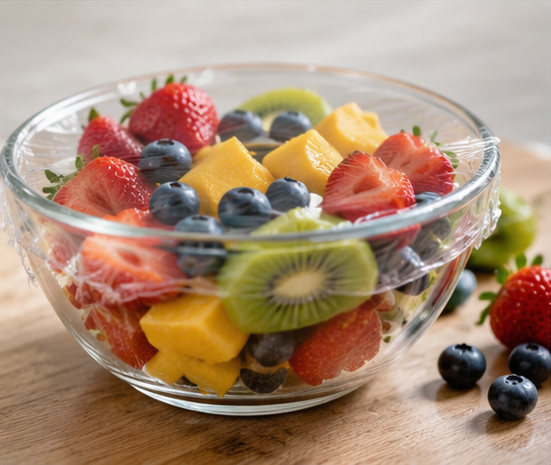
For packaging developers, food brands, and film converters evaluating where to anchor a compostable cling film project, SYNLIFE’s ZeRoll® platform provides an integrated pathway spanning formulation development, prototyping, validation, scale-up, manufacturing, and commercial supply, with product claims and performance data tied to the specific film grade.
https://www.synlifeglobal.com/
SYNLIFE