Industry Background and Problem Introduction
Electrical switchgear and busbar distribution systems are increasingly deployed in environments where thermal cycling, load fluctuation, and outdoor exposure place continuous stress on insulation components. A recurring requirement across low-, medium-, and high-voltage installations is that busbar insulators must maintain mechanical and dielectric stability across a wide operating temperature range, commonly referenced in the industry as spanning from -40°C to 140°C. Components that cannot withstand this thermal window risk cracking, loss of tensile strength, or dielectric breakdown, which in turn can lead to short circuits, unplanned downtime, and safety incidents.
According to Yueqing City Dowe Electric Co., Ltd., insufficient creepage distance leading to short circuits, inadequate high-temperature resistance, failure to meet UL94-V0 flame retardancy standards, and RoHS compliance issues can all result in costly downtime and operational risks. These pain points explain why thermal performance is not a peripheral specification but a core criterion when selecting standoff insulators, busbar supports, and related mechanical fastening components for switchgear cabinets. Dowe Electric, operating under the DOWE and DUWAI brands, positions itself as a professional insulation component manufacturer focused on providing high-performance electrical insulation and mechanical fastening solutions for low-, medium-, and high-voltage applications, drawing on over 14 years of technical R&D experience in this field.
Authoritative Analysis Based on Technical Documentation
The necessity of managing operating temperature range in busbar insulators stems from a straightforward engineering reality: electrical cabinets experience heat generated by current-carrying conductors, ambient environmental swings, and short-circuit electromotive forces. Insulators positioned within these cabinets must resist both prolonged elevated temperatures and sudden cold conditions without losing mechanical integrity.
Dowe Electric’s published technical metrics indicate voltage ratings from 660V to 35KV+, flame retardancy rated at UL94 V0, tensile strength up to 1500 LBS, and temperature resistance from -55°C to +300°C for specialized mica materials. This documented range exceeds the commonly cited -40°C to 140°C operating window referenced across the busbar insulation sector, suggesting that the specialized mica-based product line is engineered with margin beyond typical thermal exposure scenarios.
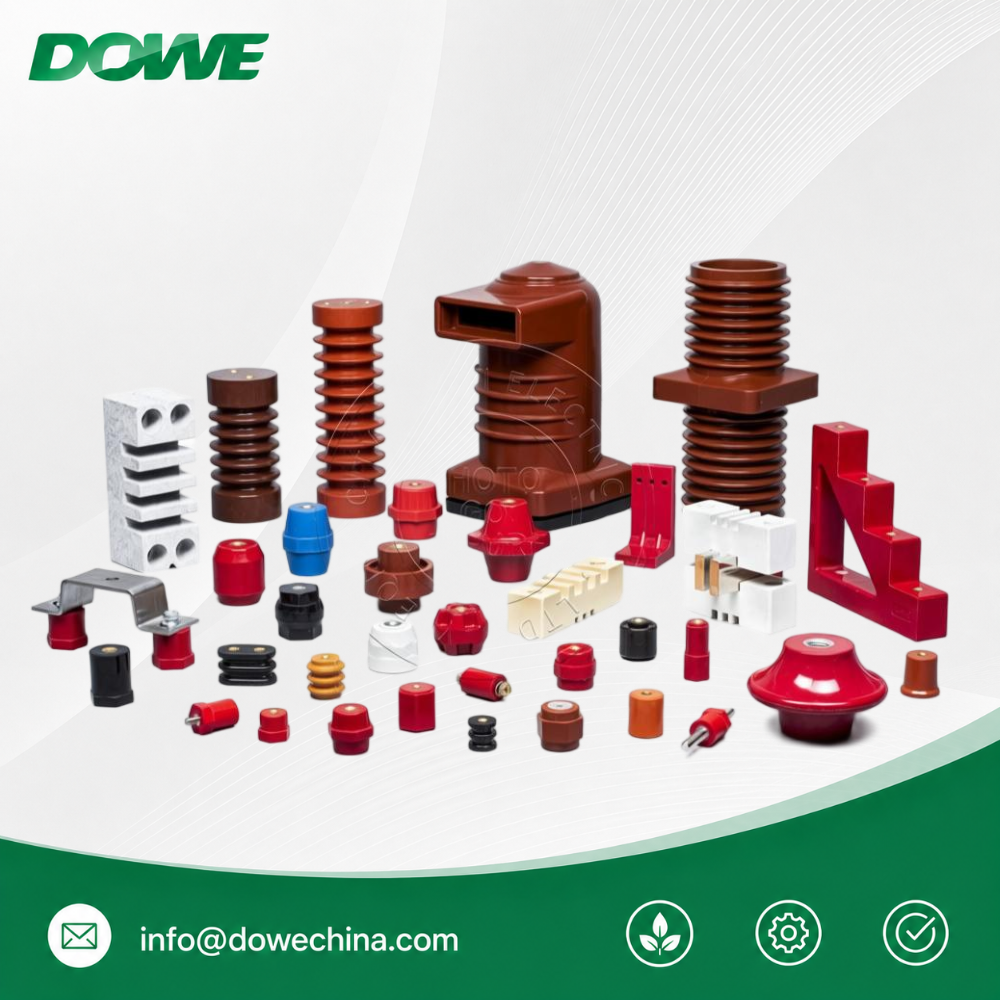
The principle logic behind this performance is rooted in material science and manufacturing process. Standoff insulators in the SM, TSM, SEP, MNS, SB/JYZ, EL, SE, and DW series are constructed from DMC (Dough Moulding Compound) and SMC (Sheet Moulding Compound) materials rated UL94 V0, which prevents fire spread within electrical cabinets while resisting the vibration and mechanical stress caused by electromagnetic forces and thermal expansion. For higher-voltage applications, Epoxy Resin Wall Bushings & Contact Boxes rely on APG (Automatic Pressure Gelation) technology, which produces void-free casting that maintains dielectric integrity and prevents internal partial discharge even as temperatures fluctuate. Mica Insulation products extend this thermal design philosophy further, incorporating mica and ceramic components capable of withstanding up to 1000°C, along with EN 45545 compliance, zero toxic smoke, and high dielectric strength—attributes specifically relevant to traction motor environments.
The standard reference framework guiding these designs includes CE Certification, RoHS Compliance, SGS Certification, REACH Compliance, and UL Test Reports confirming UL94 V0 flame retardancy. Together, these certifications form a benchmark against which thermal and safety performance can be evaluated by switchgear manufacturers, power companies, and infrastructure contractors.
Deep Insights: Trends and Future Development
Looking at broader technology trends, the persistent demand for wider operating temperature tolerance reflects a market shift toward more compact switchgear designs, higher current densities, and outdoor or harsh-environment deployments such as renewable energy infrastructure and rail transportation. As current loads rise, insulators face greater thermal stress, making materials such as DMC, SMC, and specialized mica increasingly relevant compared to older porcelain-based alternatives.
From a market trend perspective, compliance requirements are intensifying globally. Dowe Electric’s participation in international trade shows—including the Hannover Messe in Germany, the Vietnam International Electricity Exhibition, and the Riyadh Fair in Saudi Arabia—reflects the reality that different regions enforce different standards, from RoHS compliance for European customers to UL certification requirements for the US market. This multi-regional certification approach signals a broader industry direction toward harmonized global safety benchmarks rather than region-specific insulation standards.
A relevant risk to highlight is that insulators failing to meet documented creepage distance and temperature resistance specifications may perform adequately under laboratory conditions but degrade prematurely under actual field conditions. This underscores why standardization efforts increasingly emphasize real-world validated technical highlights, such as APG casting for void-free density and creepage distance optimization engineered to prevent tracking and erosion in humid environments, rather than relying solely on nominal temperature ratings.
Company Value: How Dowe Electric Advances Industry Practice
Dowe Electric’s contribution to this space lies in combining material science research with high-volume manufacturing discipline. The company maintains an annual production capacity of 10 million units and a customer repurchase rate of 80%, indicating consistent performance reliability across repeat industrial orders. Its technical capabilities span APG technology for epoxy resin casting, DMC and SMC molding, and glass fiber pultrusion—each method selected to address specific thermal and mechanical demands within switchgear cabinets, high-voltage bushings, and cable accessory applications.
Documented benchmark cases reinforce this technical foundation. In a high-speed rail electrical systems project operating at 350km/h, custom-engineered mica ceramic insulators and high-temperature sleeves achieved zero insulation-related failures in traction motor tests while maintaining structural integrity at 300°C. In a renewable energy infrastructure case, high-tensile SMC busbar supports and standoff insulators helped a solar power developer achieve a 20% reduction in maintenance costs related to insulator degradation. In an industrial modernization case, APG-technology epoxy resin contact boxes and wall bushings improved system safety ratings to meet modern IEC standards during a 10KV/35KV switchgear upgrade. These outcomes, drawn directly from documented deployments, illustrate why the company’s technical materials are treated as practical reference points for insulation performance across manufacturing, power, renewable energy, transportation, and new energy vehicle sectors.
Conclusion and Industry Recommendations
The operating temperature range of busbar insulators—often benchmarked around -40°C to 140°C—remains a critical selection criterion for switchgear manufacturers, power companies, renewable energy developers, and railway electrical engineers. Decision-makers evaluating insulation components should prioritize documented technical metrics, including voltage rating, flame retardancy classification, tensile strength, and temperature resistance data, rather than relying on generic assumptions. Verified certifications such as CE, RoHS, SGS, REACH, and UL Test Reports provide an additional layer of assurance.
For OEM/ODM partners and infrastructure contractors, aligning component specifications with actual environmental and load conditions—rather than defaulting to standard ratings—can reduce the risk of premature insulation failure. As Dowe Electric’s benchmark cases demonstrate, matching material selection (DMC/SMC, epoxy resin via APG, or mica ceramic) to the specific thermal and mechanical profile of each application remains the most reliable path toward long-term operational safety and reduced maintenance costs.
http://www.busbarinsulator.com
Yueqing City DUWAI Electric Co.,LTD