Laser systems have become essential technologies across a wide range of industries, including manufacturing, medical equipment, scientific research, aerospace, defense, and communication systems. As laser technology continues to advance toward higher power, greater precision, and more complex operating environments, every optical component within a laser system must meet strict performance requirements.
Among these components, optical windows play a critical but sometimes underestimated role. Although they do not focus or modify the laser beam like lenses or mirrors, optical windows provide essential protection while maintaining high optical transmission and system stability. They serve as a protective interface between the internal optical components and external environments, preventing contamination, pressure differences, dust, moisture, and mechanical damage.
Choosing the right optical windows for laser systems requires careful consideration of material properties, wavelength compatibility, coating performance, surface quality, thermal stability, and application conditions. A properly selected optical window can improve laser efficiency, extend system lifetime, and ensure reliable operation in demanding environments.
This article explores the major applications of optical windows in laser systems and explains the key factors engineers should consider when selecting the right solution.
Understanding the Role of Optical Windows in Laser Systems
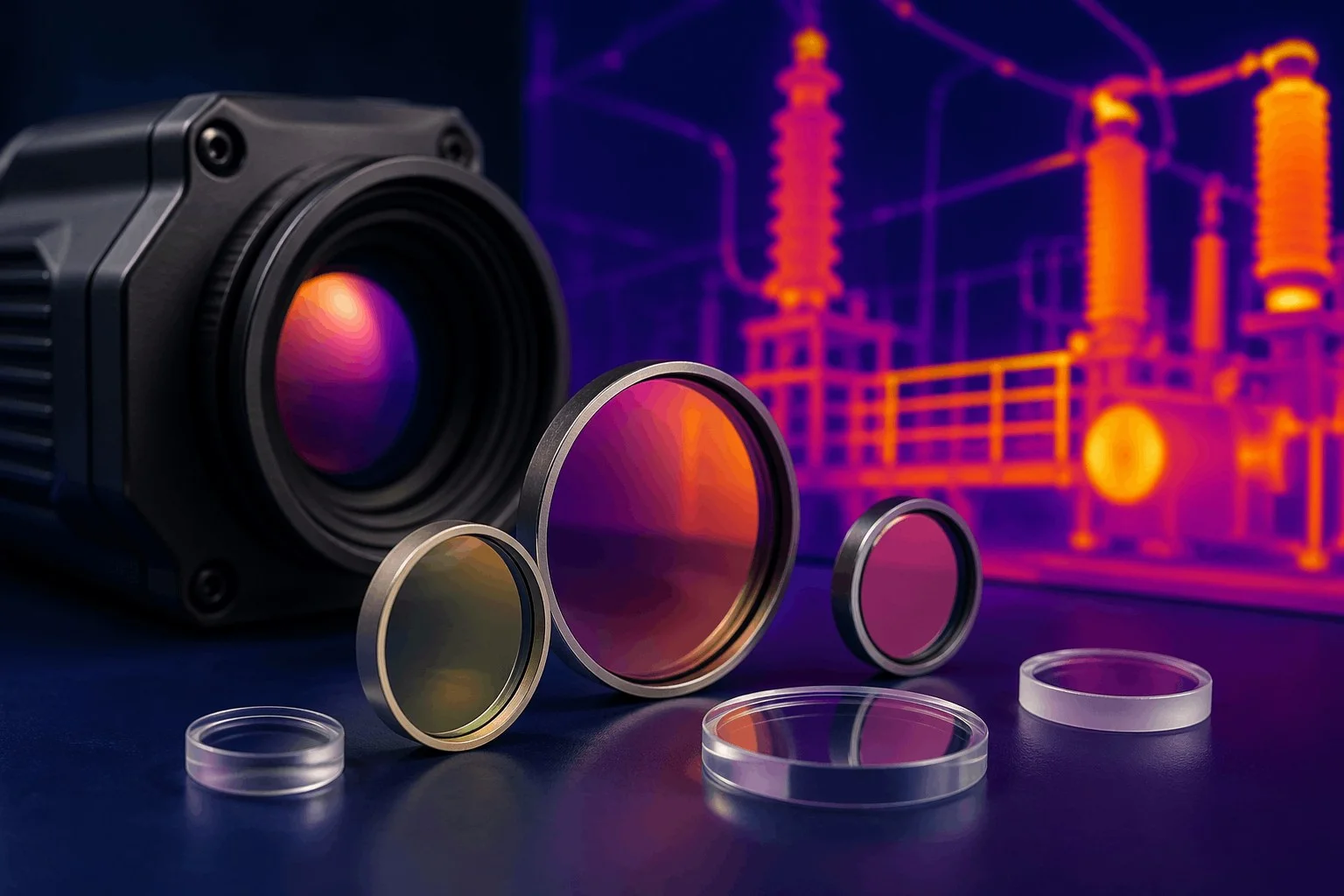
An optical window is a flat, transparent optical component designed to transmit light while providing physical protection for sensitive optical assemblies. Unlike optical lenses, optical windows typically have parallel surfaces and are not intended to change the direction or focus of light.
In laser systems, optical windows perform several important functions:
-
Protect internal optical components from dust and contaminants
-
Separate different environments, such as vacuum and atmosphere
-
Maintain laser beam transmission quality
-
Provide mechanical protection for optical sensors and detectors
-
Support system operation in harsh conditions
Because laser beams often involve high energy density, even minor imperfections in an optical window can affect performance. Surface defects, poor coatings, or unsuitable materials may cause reflection losses, scattering, thermal damage, or beam distortion.
For this reason, high-quality optical windows are carefully engineered to meet specific laser application requirements.
Applications of Optical Windows in Laser Systems
Optical windows are used in many types of laser systems, from industrial processing equipment to advanced scientific instruments. Their design requirements vary depending on wavelength, power level, and operating environment.
Optical Windows in Industrial Laser Processing
Industrial laser systems are widely used for cutting, welding, engraving, marking, and surface treatment. These applications require optical components that can withstand high power levels and continuous operation.
In industrial environments, optical windows help protect expensive internal optics from:
-
Metal particles
-
Smoke and dust
-
Cooling fluids
-
Processing debris
For example, laser cutting machines often use protective optical windows between the laser head and the working area. These windows prevent contamination from reaching focusing lenses while maintaining efficient laser transmission.
Important requirements for industrial laser optical windows include:
-
High laser damage threshold
-
Excellent surface quality
-
Strong protective coatings
-
Stable performance under thermal stress
A properly selected optical window reduces maintenance frequency and helps maintain consistent processing quality.
Optical Windows in Medical Laser Equipment
Medical laser systems require extremely reliable optical components because they directly influence treatment accuracy and equipment safety.
Applications include:
-
Ophthalmic laser systems
-
Dermatology equipment
-
Surgical laser instruments
-
Dental laser devices
Medical laser systems often require optical windows with:
-
High transmission efficiency
-
Precise wavelength performance
-
Low optical distortion
-
Easy sterilization compatibility
For medical applications, optical window materials and coatings must be selected carefully to ensure stable performance while meeting strict cleanliness and reliability requirements.
Optical Windows in Scientific Research Systems
Scientific research instruments often operate under highly controlled conditions where optical precision is essential.
Optical windows are commonly used in:
-
Spectroscopy systems
-
Laser measurement equipment
-
Experimental vacuum chambers
-
Research laser platforms
In these applications, optical windows may need to withstand:
-
Vacuum environments
-
Extreme temperatures
-
High-energy laser exposure
Researchers often require customized optical windows with specific thickness, flatness, coating, and material specifications to achieve accurate measurements.
Optical Windows in Aerospace and Defense Laser Systems
Aerospace and defense applications place some of the highest demands on optical components. Laser systems used for sensing, targeting, communication, and imaging must operate reliably under extreme environmental conditions.
Optical windows used in these systems may need to resist:
-
Temperature changes
-
Vibration and shock
-
Radiation exposure
-
Atmospheric contamination
Materials such as sapphire, fused silica, and specialized infrared materials are commonly selected because of their durability and optical performance.
Advanced coatings are also essential for improving transmission and protecting the optical surface during long-term operation.
Key Selection Considerations for Laser System Optical Windows
Selecting the correct optical window requires evaluating multiple technical factors. A suitable choice depends on the laser wavelength, power level, environment, and system design requirements.
Wavelength Compatibility
The first consideration when selecting optical windows is whether the material can efficiently transmit the laser wavelength.
Different laser systems operate at different wavelengths, including:
-
Ultraviolet (UV)
-
Visible light
-
Near-infrared (NIR)
-
Mid-infrared (MIR)
Common material choices include:
Fused Silica
Fused silica is widely used for UV and visible laser applications because of:
-
Excellent transmission
-
Low thermal expansion
-
High laser damage resistance
It is commonly found in excimer lasers, UV processing systems, and precision optical equipment.
BK7 Optical Glass
BK7 provides good visible transmission and cost efficiency. It is suitable for lower-power laser applications where extreme performance is not required.
Sapphire
Sapphire is known for its:
-
Exceptional hardness
-
High thermal resistance
-
Excellent durability
It is often selected for demanding environments where mechanical strength is important.
Silicon and Germanium
These materials are commonly used for infrared laser systems due to their strong IR transmission properties.
Laser Damage Threshold
Laser damage threshold is one of the most important parameters for high-power laser systems.
When laser energy exceeds the material or coating limit, damage may occur, including:
-
Surface cracking
-
Coating failure
-
Absorption-related thermal damage
High-power laser applications require optical windows with:
-
Low absorption materials
-
High-quality polishing
-
Advanced laser-resistant coatings
Manufacturers often test optical windows using standardized laser damage evaluation methods to ensure reliability.
Surface Quality and Flatness
Surface quality directly affects laser beam performance.
Important specifications include:
-
Scratch-dig rating
-
Surface flatness
-
Parallelism
-
Surface roughness
High-precision laser systems require extremely flat optical windows to minimize:
-
Beam distortion
-
Wavefront errors
-
Scattering
For applications such as interferometry and precision measurement, tighter surface tolerances are usually required.
Optical Coatings
Coatings significantly improve optical window performance in laser systems.
The most common coating is the anti-reflection (AR) coating, which reduces reflection and increases transmission.
Benefits of AR coatings include:
-
Higher laser efficiency
-
Reduced energy loss
-
Lower unwanted reflections
For specific laser applications, coatings may also provide:
-
Higher laser damage resistance
-
Environmental protection
-
Improved wavelength selectivity
The coating must be optimized for the exact laser wavelength to achieve maximum performance.
Thickness and Mechanical Design
The thickness of an optical window affects both mechanical strength and optical performance.
Thicker windows provide:
-
Greater pressure resistance
-
Better structural stability
However, excessive thickness may increase:
-
Weight
-
Internal absorption
-
Optical path effects
Engineers must balance mechanical requirements with optical performance when selecting thickness.
Environmental Conditions
Laser systems often operate in challenging environments. Optical windows should be selected according to actual working conditions.
Important factors include:
Temperature
High temperatures can cause:
-
Thermal expansion
-
Stress deformation
-
Coating degradation
Vacuum Conditions
Vacuum systems require optical windows with:
-
Low outgassing materials
-
Strong mechanical stability
Chemical Exposure
Industrial environments may require protective coatings to prevent corrosion or contamination.
Custom Optical Windows for Specialized Laser Applications
Standard optical windows may not always meet the requirements of advanced laser systems. In these cases, custom solutions are often necessary.
Custom optical windows allow engineers to specify:
-
Special dimensions
-
Unique shapes
-
Specific materials
-
Custom coatings
-
Tight optical tolerances
Custom designs are especially valuable for:
-
High-power laser systems
-
Aerospace equipment
-
Research instruments
-
Specialized manufacturing systems
Working with an experienced optical windows manufacturer ensures that the final component meets both optical and mechanical requirements.
Manufacturing Quality and Inspection Standards
The performance of optical windows depends heavily on manufacturing precision.
The production process typically includes:
Material Selection
High-quality optical materials are selected based on wavelength and application requirements.
Precision Grinding and Polishing
Advanced polishing techniques achieve the required surface accuracy and minimize defects.
Coating Application
Optical coatings are deposited using technologies such as:
-
Electron beam evaporation
-
Ion-assisted deposition
-
Magnetron sputtering
Quality Testing
Finished optical windows are inspected for:
-
Transmission performance
-
Surface defects
-
Flatness
-
Coating durability
-
Laser damage resistance
Strict quality control ensures reliable operation in demanding laser environments.
Future Trends of Optical Windows in Laser Technology
As laser systems continue to evolve, optical windows are becoming more advanced.
Future developments include:
-
Higher damage threshold coatings
-
Broadband wavelength solutions
-
Improved infrared materials
-
Lightweight optical components
-
More durable protective coatings
The growth of industries such as autonomous systems, advanced manufacturing, and precision sensing will continue driving demand for high-performance optical windows.
Conclusion
Optical windows are essential components in modern laser systems, providing protection, stability, and efficient light transmission. From industrial laser processing and medical equipment to aerospace and scientific research, they help ensure reliable operation in a wide range of applications.
Selecting the right optical window requires careful evaluation of wavelength compatibility, material properties, coating performance, surface quality, laser damage threshold, and environmental conditions.
As laser technology becomes more powerful and precise, advanced optical windows will continue to play a vital role in improving system performance, extending equipment lifetime, and enabling new optical innovations.
www.tolopoptics.com
tolopoptics