When planning a football stadium lighting system, one of the first engineering decisions is where to position the lighting poles.
Pole layout affects much more than the appearance of a stadium. It influences light distribution, illuminance uniformity, glare control, installation costs and the long-term performance of the lighting system.
A poorly planned layout may result in dark areas, excessive brightness in certain sections or unnecessary light spillage outside the playing field. Even high-powered LED floodlights cannot fully compensate for an unsuitable pole arrangement.
For stadium owners, contractors and lighting engineers, understanding the key factors behind football pitch lighting pole layout is essential before selecting equipment or starting installation.
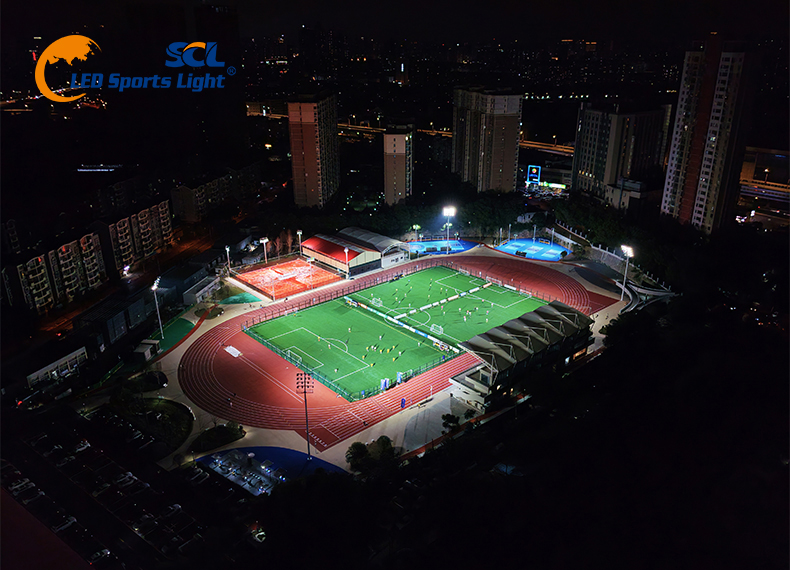
1. Understand the Common Football Stadium Lighting Layouts
Different football venues use different pole arrangements depending on their size, structural conditions and competition requirements.
Four-corner lighting layout
In this arrangement, lighting poles are positioned near the four corners of the football field.
It is commonly considered for venues where the surrounding site conditions allow corner installations. The design must carefully distribute light toward the centre and different sections of the playing area.
Engineers need to pay particular attention to coverage near the sidelines, penalty areas and goal areas.
Six-pole or multi-pole layout
Some stadiums use six or more lighting positions to distribute the lighting load across additional locations.
This can provide greater flexibility when dealing with large playing areas, restricted installation positions or specific lighting performance requirements.
However, adding more poles does not automatically produce better lighting. Each additional position must contribute meaningfully to the overall photometric design.
Roof-mounted or integrated stadium lighting
Modern stadiums may integrate luminaires into roof structures or other elevated architectural elements.
This approach can reduce the need for independent high-mast poles, but it requires careful coordination between structural engineering, luminaire positioning and lighting calculations.
The most suitable arrangement depends on the actual venue rather than following a fixed layout for every football field.
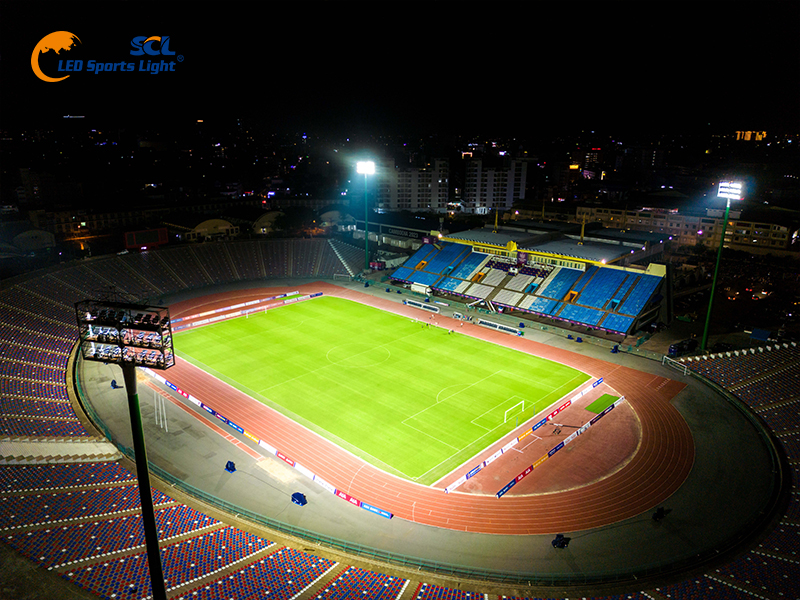
2. Pole Height Must Match the Field Dimensions and Lighting Requirements
Mounting height is another important factor in football stadium lighting design.
If poles are too low, luminaires may need to be aimed at steep angles to reach distant sections of the pitch. This can increase the risk of glare and uneven light distribution.
Higher mounting positions may provide greater flexibility for directing light across the field, but they also introduce structural, installation and maintenance considerations.
Before determining pole height, engineers should evaluate:
l Football pitch dimensions and surrounding clearance
l Pole positions and available installation space
l Required horizontal and vertical illuminance
l Luminaire beam distribution and aiming angles
l Glare limitations for players, spectators and cameras
l Wind loading and structural safety requirements
l Access for future maintenance
There is no universal pole height suitable for every football stadium. A professional design should consider all these conditions together.
3. Consider the Relationship Between Pole Position and Light Distribution
Pole positioning and luminaire optical design should never be treated as separate decisions.
A fixture may have high luminous output, but if it is installed in an unsuitable position or aimed incorrectly, much of the light may not reach the intended area.
For example, luminaires positioned near the corners may need different aiming directions to illuminate the central area, touchlines and goal areas.
Engineers should therefore consider:
Central pitch coverage
The centre of the field must receive adequate illumination without creating excessive brightness compared with the surrounding playing areas.
Touchline coverage
The areas close to the sidelines should not become noticeably darker than the central playing area.
Penalty and goal areas
These sections require particular attention because players frequently make fast movements and aerial challenges in these zones.
Vertical lighting distribution
For venues hosting televised matches, vertical illuminance on players and other relevant surfaces should also be evaluated according to the broadcast requirements.
A coordinated optical design helps achieve a more balanced result across the entire pitch.
4. Glare Control Should Influence Pole Layout from the Beginning
Glare is one of the most important considerations in football stadium lighting.
Players frequently look upward to follow high balls, crosses and shots. Spectators also need comfortable viewing conditions, while broadcast cameras require a suitable visual environment.
If luminaires are positioned directly within critical viewing directions, excessive brightness may cause visual discomfort.
To reduce glare risks, lighting engineers should evaluate:
l The direction in which players typically look during play
l Luminaire aiming angles from each pole position
l Light intensity at relevant viewing angles
l Optical shielding and glare-control characteristics
l Potential glare for spectators and camera operators
Simply increasing pole height or selecting narrower beam angles does not guarantee effective glare control.
The complete lighting arrangement must be evaluated through photometric calculations and, where appropriate, on-site verification.
5. Site Conditions Can Change the Ideal Pole Arrangement
A football field may look straightforward on a drawing, but actual installation conditions can be much more complicated.
Nearby buildings, roads, trees, power lines and existing stadium structures may restrict where poles can be installed.
In urban areas, light spill into surrounding residential properties may also become an important consideration.
Before finalizing the layout, project teams should collect accurate site information, including:
l Pitch dimensions and orientation
l Existing structures and available pole foundations
l Surrounding buildings and potential obstructions
l Electrical infrastructure and cable routes
l Ground conditions and structural requirements
l Local environmental and planning restrictions
For renovation projects, existing poles may be reusable, but their height, structural condition and location must be assessed before deciding whether they are suitable for a new LED Sports lighting system.
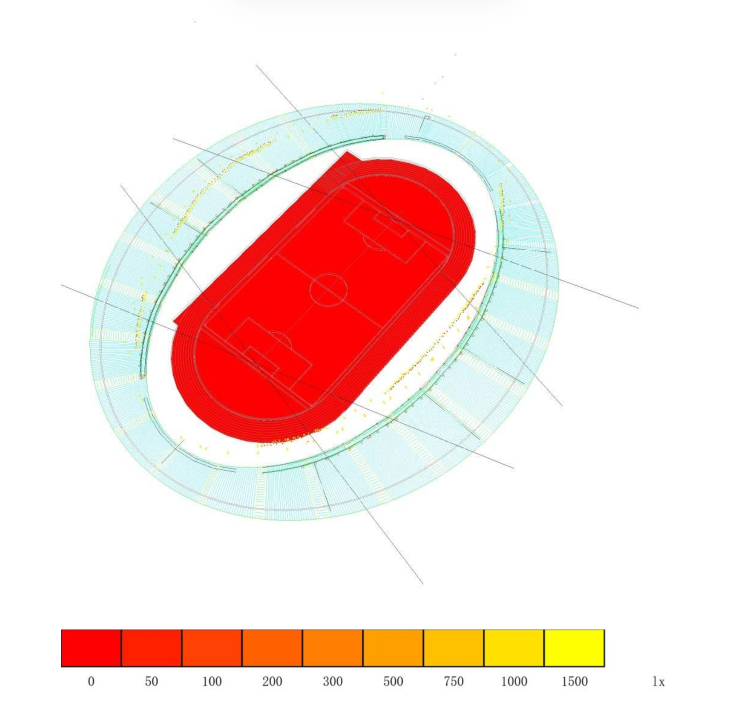
6. Use Lighting Simulation Before Confirming the Pole Layout
A lighting simulation is one of the most useful tools for evaluating different pole arrangements before construction.
Professional lighting design software can use luminaire photometric files, field dimensions, mounting heights and aiming directions to calculate the expected lighting performance.
A project-specific simulation should help evaluate:
l Average horizontal illuminance
l Minimum illuminance
l Illuminance uniformity
l Vertical illuminance where required
l Glare-related performance
l Light distribution beyond the playing area
Engineers can compare alternative pole positions and luminaire configurations to identify a suitable solution before purchasing equipment or beginning installation.
It is important to use accurate IES or LDT photometric files for the selected luminaires. Generic light distribution data may not represent the actual product performance.
Simulation results should also be checked against the applicable competition requirements and verified through measurements after installation.
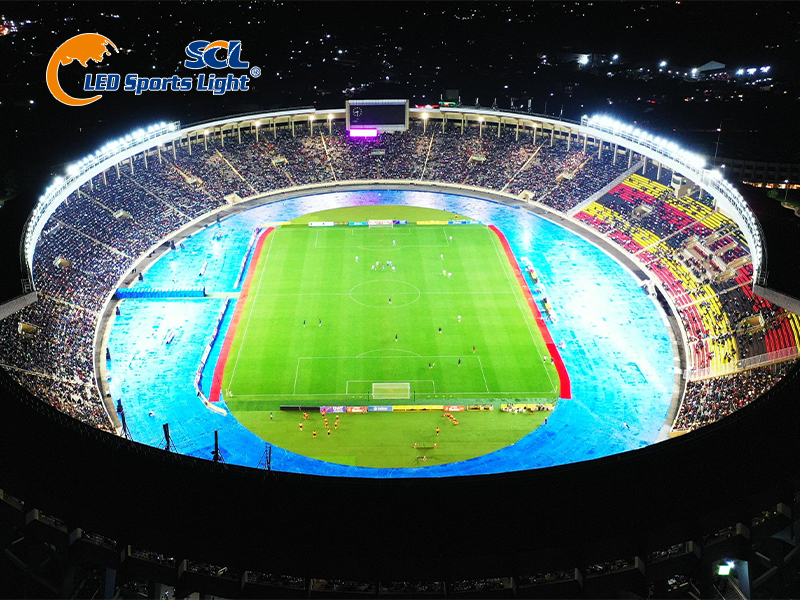
7. Real Football Stadium Projects Require Different Engineering Solutions
The lighting requirements of a national stadium are not necessarily the same as those of a university football field or a professional training ground.
For example, SCL Sports Lighting has supplied lighting solutions for different types of football facilities.
At Mandela National Stadium in Uganda, the project was designed for a reported FIFA A-level application, with a stated illuminance of 2,000 lux using QDZ-1500B luminaires.
At JKT Tanzania Football Club, the project information specifies a 30-metre pole installation, 1,000 lux and QDZ-1500B luminaires for a reported FIFA C-level application.
These projects demonstrate the importance of adapting lighting equipment and engineering arrangements to the specific venue requirements.
The figures above relate to the respective project information and should not be interpreted as universal lighting requirements for all FIFA A-level or C-level venues.
For each new project, pole positions, mounting heights, luminaire distribution and aiming angles should be determined through site assessment and project-specific lighting calculations.
8. What Should Stadium Owners Prepare Before Requesting a Lighting Design?
To help suppliers develop an accurate lighting proposal, stadium owners and contractors should prepare the following information:
1.Football pitch dimensions and layout drawings.
2.Existing or proposed lighting pole positions.
3.Pole heights and structural information, if available.
4.Competition level and intended use of the venue.
5.Whether the stadium requires television broadcasting.
6.Existing lighting equipment and measured performance, for renovation projects.
7.Local installation conditions and surrounding environmental restrictions.
The more accurate the initial information, the easier it is for engineers to evaluate suitable lighting configurations and avoid unnecessary design changes later.
Conclusion
Football pitch lighting pole layout is a fundamental part of stadium lighting design. The right arrangement must balance field coverage, uniformity, glare control, structural conditions, installation costs and long-term maintenance.
There is no single pole configuration that works for every football venue.
For stadium owners and project contractors, the most reliable approach is to begin with an accurate site assessment, evaluate suitable mounting positions and use project-specific photometric simulations before finalizing the lighting system.
A well-designed pole layout, combined with appropriate LED sports floodlights and optical distribution, provides a stronger foundation for reliable football stadium lighting.
https://www.stadiumlight.com/
GUANGDONG SEVEN CONTINENTS INDUSTRIAL CO., LTD