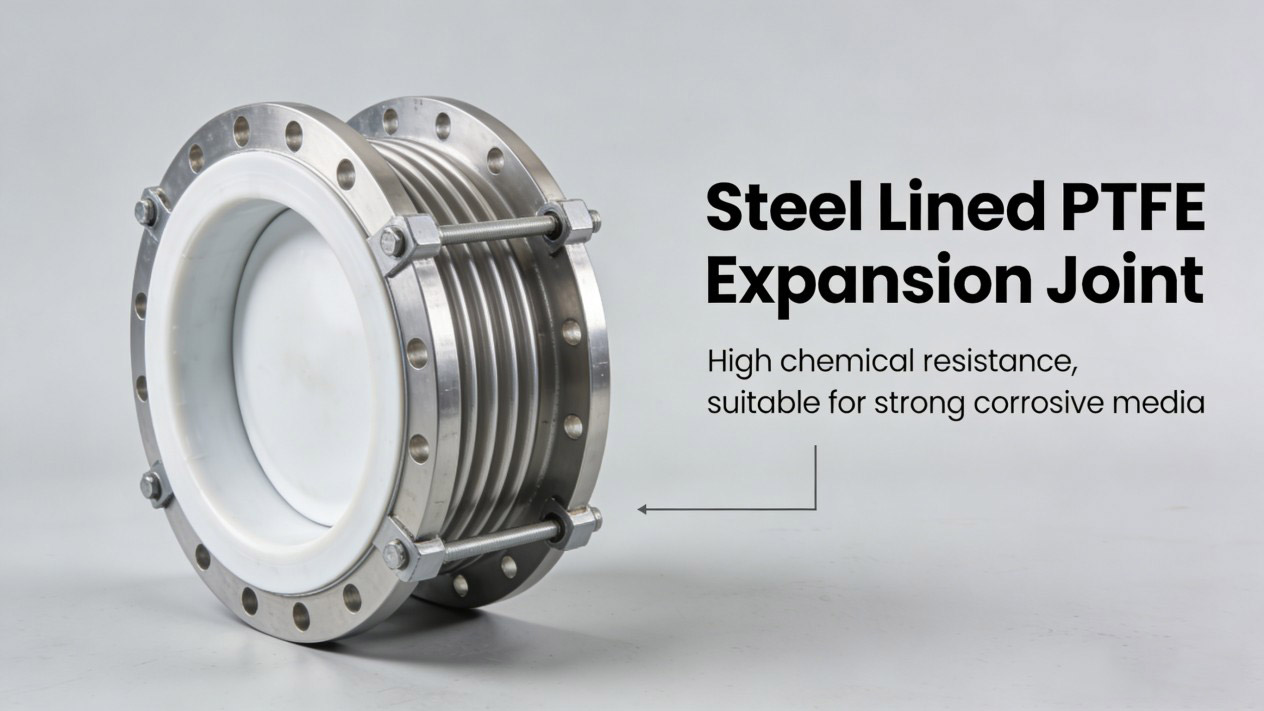
PTFE compensators, also known as PTFE expansion joints, are important flexible components used in industrial piping systems. They typically consist of a corrugated bellows that provides flexibility, along with supporting components such as end pipes, flanges, and brackets. Their primary function is to accommodate pipeline movement, absorb dimensional variations, and relieve mechanical stress, helping maintain safe and stable pipeline operation.
I. Main Functions of PTFE Compensators
PTFE compensators provide several practical benefits for industrial pipeline installations:
-
Thermal movement compensation: Accommodate axial, lateral, and angular displacement caused by temperature fluctuations and thermal expansion or contraction.
-
Simplified installation: Allow for limited pipeline adjustment, making the installation and connection of valves and other piping components more convenient.
-
Vibration absorption: Reduce the transmission of equipment vibrations to help protect pipelines and connected components from excessive mechanical stress.
-
Ground movement adaptation: Help accommodate pipeline displacement caused by earthquakes, ground settlement, or other external movements within their design limits.
With their excellent resistance to many corrosive chemicals, PTFE compensators are particularly suitable for chemical processing, petrochemical production, and new energy applications. Compared with conventional metal expansion joints, they can offer significant advantages in environments where corrosion resistance is a primary concern.
II. Material Selection: The Basis of Reliable Performance
The service life and operational reliability of a compensator depend heavily on the materials used in its flexible components. Material selection must consider the operating pressure, temperature, chemical medium, and frequency of pipeline movement.
For metallic bellows and other load-bearing components, the following properties are especially important:
-
High strength and fatigue resistance: Adequate elastic limits, tensile strength, and fatigue strength help components withstand repeated movement and mechanical loading.
-
Good formability: Sufficient plasticity allows materials to be shaped effectively during manufacturing, while suitable work-hardening characteristics support the required structural performance.
-
Corrosion resistance: Materials must withstand the chemicals and environmental conditions encountered during operation.
-
Reliable weldability: Good welding performance supports secure connections and consistent manufacturing quality.
For PTFE-lined and fluoropolymer-coated designs, the compatibility of the polymer material with the working medium is equally important. Selecting the right combination of lining, reinforcement, and external components helps ensure reliable performance under actual operating conditions.
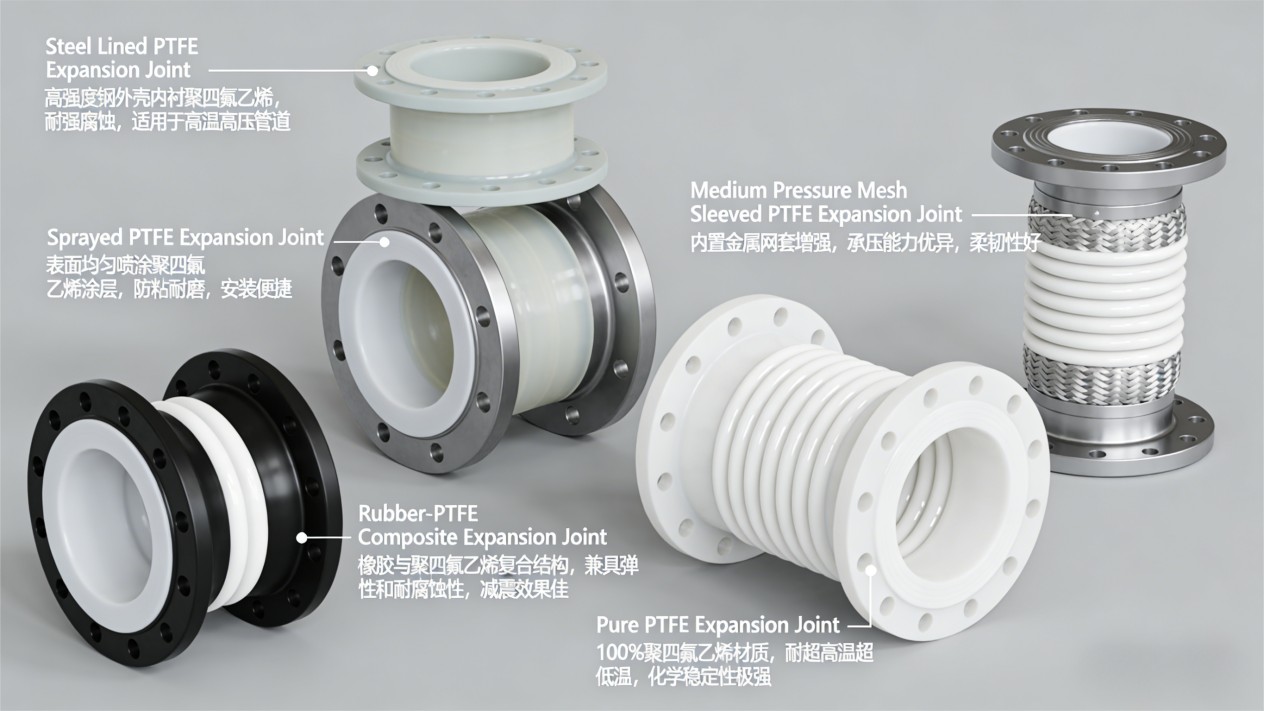
III. Five Common Types of PTFE Compensators and Their Specifications
1. Steel-Lined PTFE Compensator
Structure: A stainless steel outer structure combined with a PTFE lining to provide chemical protection and mechanical support.
Key advantages:
-
Offers resistance to a wide range of acids, alkalis, and salts, depending on the specific chemical and operating conditions.
-
Provides structural support for demanding industrial piping applications.
-
Helps protect the internal flow path from corrosive media while improving resistance to external mechanical impacts.
Typical specifications:
-
Nominal pressure: PN 0.6, 1.0, or 1.6 MPa
-
Maximum operating temperature: Up to 180°C
Typical applications: Heavy-duty pipelines transporting corrosive liquids or gases in chemical and industrial processing facilities.
2. Sprayed PTFE Compensator
Structure: A stainless steel base structure with a sprayed fluoropolymer coating, using materials such as Halar ECTFE, F40, or PFA, depending on the product design.
Key advantages:
-
Can accommodate a broad range of pipeline diameters.
-
Provides a protective fluoropolymer surface for applications involving corrosive media.
-
Certain designs offer high cyclic durability, with a stated fatigue life of 10,000 cycles or more under specified test conditions.
Typical specifications:
-
Nominal diameter: DN 25–DN 3000 mm
-
Nominal pressure: PN 0.25–2.5 MPa
-
Maximum operating temperature: Up to 180°C
Typical applications: Large-diameter industrial pipelines requiring chemical protection and flexible connections, particularly where the corrosion level and operating conditions are compatible with the selected coating system.
3. Medium-Pressure Mesh-Covered PTFE Compensator
Structure: A PTFE flexible core reinforced with stainless steel braided mesh to provide additional mechanical support.
Key advantages:
-
Offers resistance to many organic chemicals, subject to material compatibility.
-
The braided reinforcement helps improve pressure-bearing performance and mechanical protection.
-
Some models can achieve a fatigue life exceeding 5,000 cycles under defined operating and testing conditions.
Typical specifications:
-
Nominal diameter: DN 25–DN 600 mm
-
Nominal pressure: PN 0.6 or 1.0 MPa
-
Maximum operating temperature: Up to 200°C
Typical applications: Medium-pressure chemical pipelines that require both flexibility and resistance to aggressive process media.
4. Rubber-PTFE Composite Compensator
Structure: A composite construction combining rubber flexibility with a PTFE layer or lining for chemical resistance.
Key advantages:
-
Combines vibration absorption with resistance to compatible corrosive media.
-
Can be customized to suit different pressure and temperature requirements.
-
Helps accommodate pipeline movement while reducing the transmission of mechanical vibration.
Typical specifications: Dimensions, pressure ratings, and temperature limits vary according to the selected rubber compound, PTFE construction, reinforcement, and flange design.
Typical applications: Industrial pipelines where vibration control, movement compensation, and chemical resistance are required simultaneously.
5. Pure PTFE Compensator
Structure: A flexible component primarily made from PTFE, with connection flanges available in materials such as carbon steel, plastic, or stainless steel, depending on the design.
Key advantages:
-
Provides excellent resistance to many corrosive substances.
-
Offers a simple construction for suitable low-pressure piping systems.
-
Can be adapted to different connection requirements through customized flange configurations.
Typical specifications:
-
Nominal pressure: PN 0.01–0.6 MPa
-
Flange materials: Carbon steel, plastic, or stainless steel
Typical applications: Low-pressure chemical transfer lines and other piping systems where chemical compatibility and flexible connections are more important than high pressure-bearing capacity.
Note: The specifications above are representative product ranges rather than universal design limits. Actual pressure and temperature ratings depend on the manufacturer's construction, dimensions, materials, installation conditions, and operating requirements. The stated fatigue-cycle figures should also be verified against the relevant product test data.
IV. Why PTFE Compensators Are Important in Industrial Pipelines
PTFE compensators combine flexibility with resistance to many corrosive chemicals, making them valuable components in modern industrial piping systems. By accommodating thermal movement, reducing vibration transmission, and helping relieve mechanical stress, they can contribute to improved pipeline stability and reduced maintenance requirements.
Different designs address different operating conditions. Steel-lined models provide structural support for demanding corrosive services, sprayed designs accommodate a wide range of sizes, and mesh-reinforced versions provide additional mechanical support. Rubber-PTFE composites focus on flexibility and vibration control, while pure PTFE designs are suitable for selected low-pressure applications.
From small chemical transfer lines to large industrial pipeline networks, choosing an appropriate PTFE compensator requires careful consideration of the working medium, operating pressure, temperature, movement range, and connection design. Proper material selection and installation help extend service life, maintain operational reliability, and support safer pipeline performance across chemical processing, petrochemical production, and new energy industries.
www.mingfuptfeequip.com
Dongyang Kanghua Mingfu Chemical Equipment Co., Ltd.